Subotica Synagogue: Too Striking for Szeged
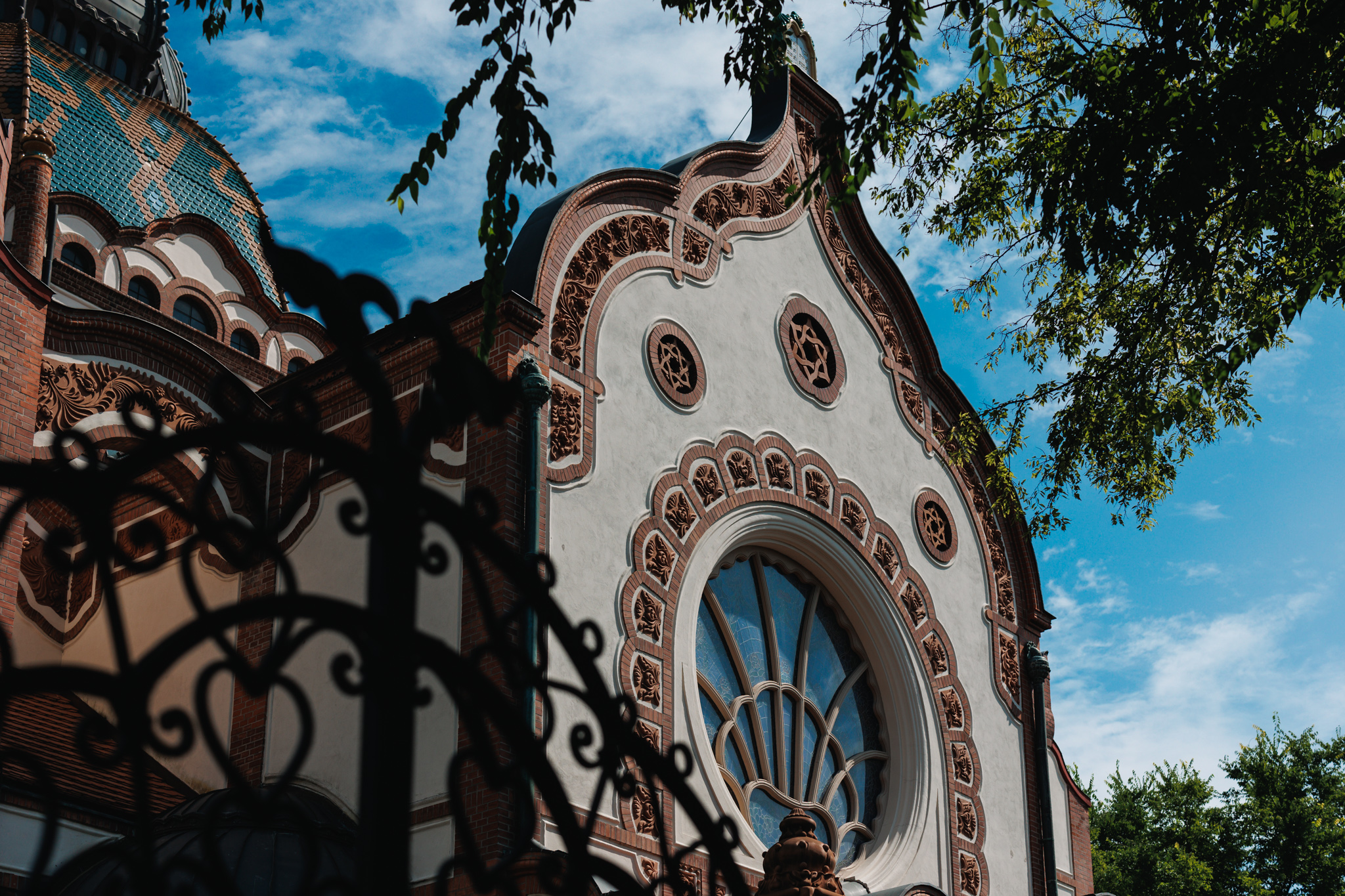
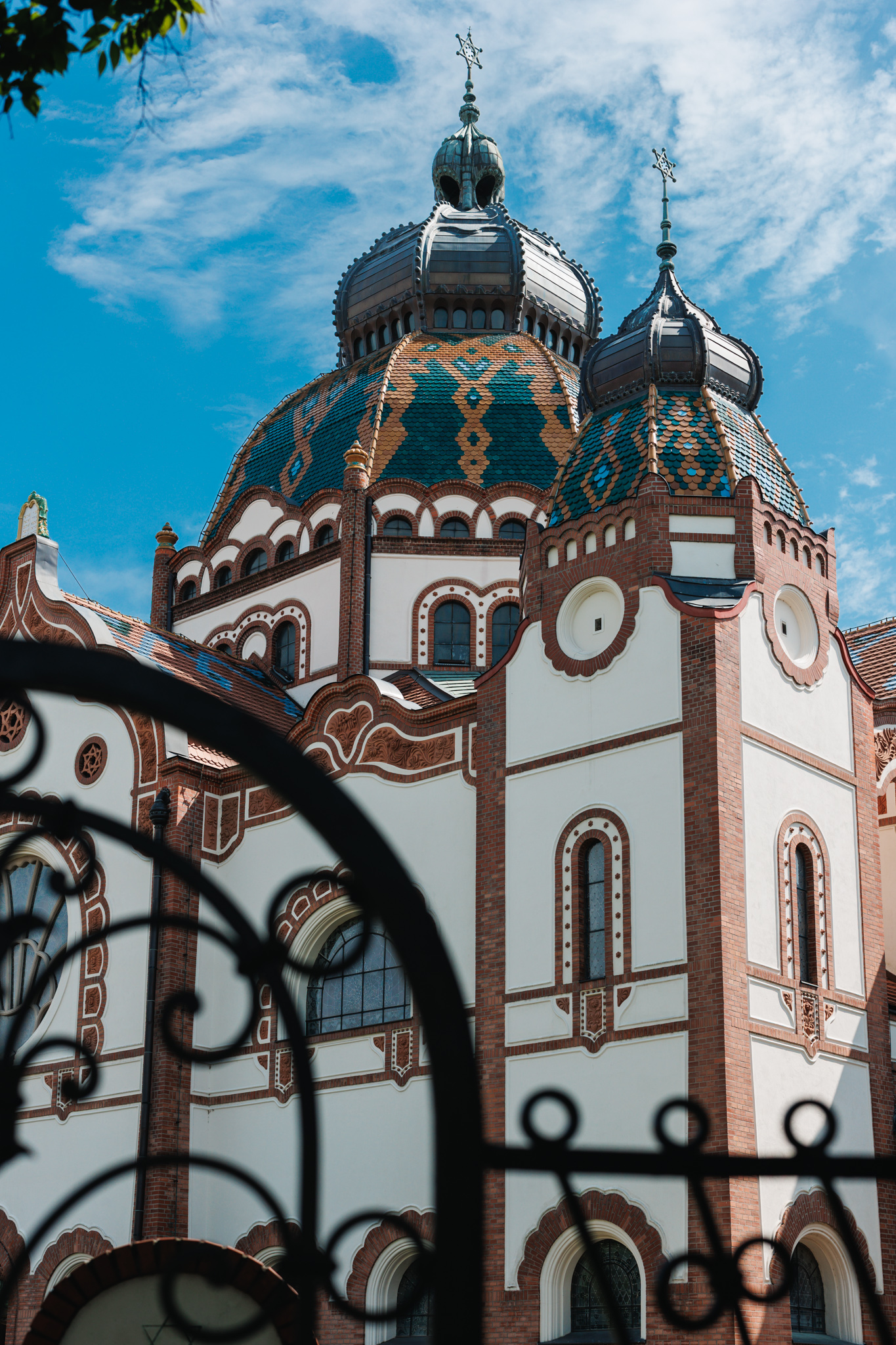
I first saw Subotica’s synagogue through its iron railings. White walls were edged in reddish brick and moulded tiles. Stars of David sat in round frames on the gable, above a window that opened like a fan. Higher up, two domes wore a pattern of green, orange and gold.
Nobody seems to have asked it to keep its voice down.
Too striking for Szeged
The design was not originally meant for Subotica. Around 1900, the Jewish community of Szeged, just across today’s Hungarian border, held a competition for a new synagogue. First prize went to Lipót Baumhorn, whose synagogue in Novi Sad I had visited the day before. The entry by two Budapest architects, Marcell Komor and Dezső Jakab, was judged too radical. It came second, and the jury recommended buying the plans anyway, which is a polite way of saying no.
Subotica’s Jewish community took it. Building began in 1900, the synagogue was finished in 1902, and it was consecrated the following year.
What made it radical was the style. Through the nineteenth century, synagogues in Central Europe often looked east for their architecture. Budapest’s Dohány Street Synagogue, completed in 1859, has horseshoe arches and onion-topped towers in the Moorish style. Jakab had worked briefly for Ödön Lechner, who was trying to build a Hungarian national style out of folk art and village craft. The pair followed his lead and gave the synagogue that style instead: the Hungarian Secession, Hungary’s own version of Art Nouveau.
A synagogue of the day often dressed as a distant palace. This one came in local embroidery.
It is considered the first building in Subotica in Hungarian Art Nouveau. A few years later, the same architects designed the City Hall, now home to a rather decorative McDonald’s. Subotica is now known for its Art Nouveau, and the square outside the synagogue bears the architects’ names.
Szeged found the design too striking. Subotica seems to have thought that was the point.
Embroidery under a dome
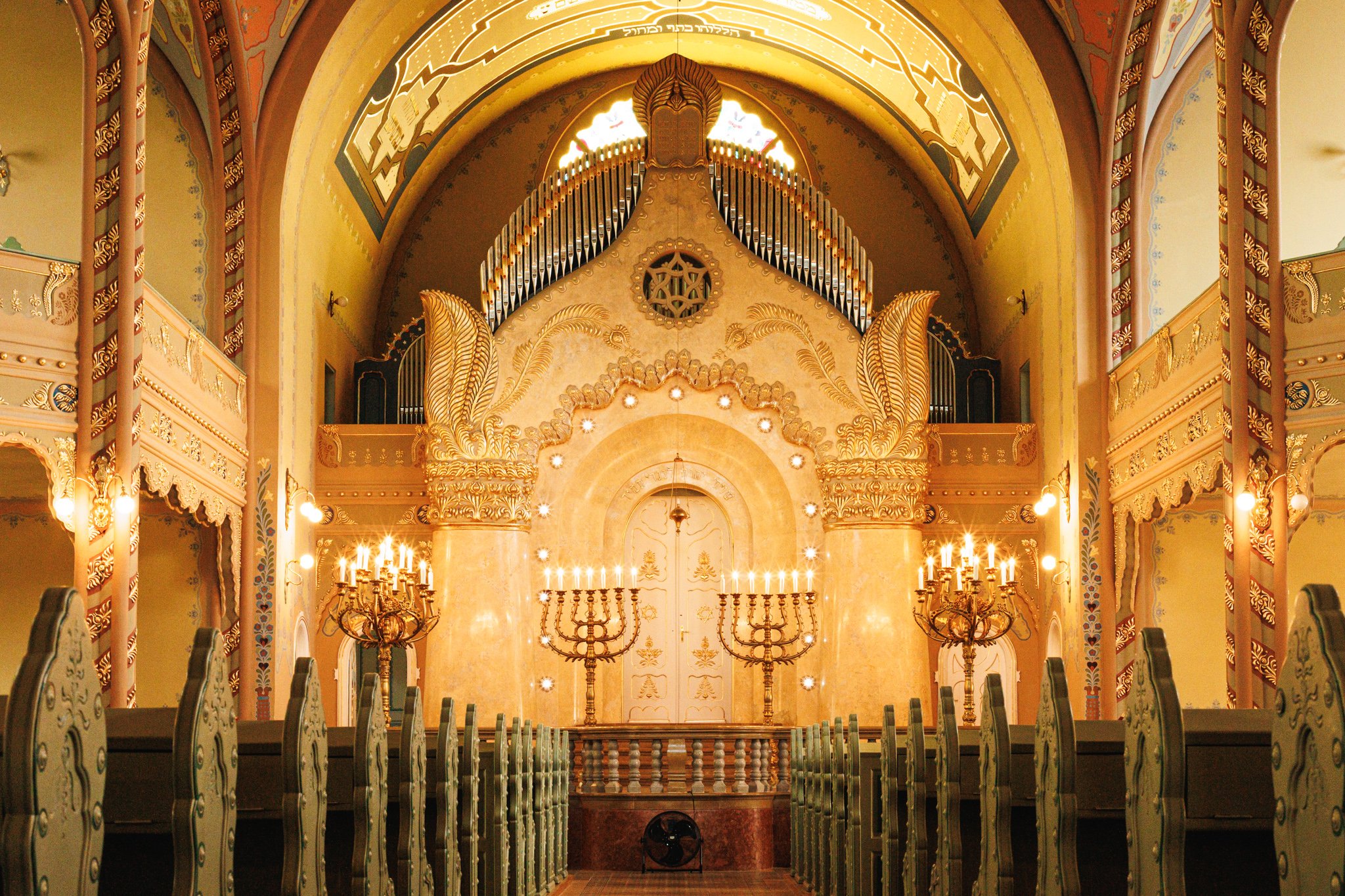
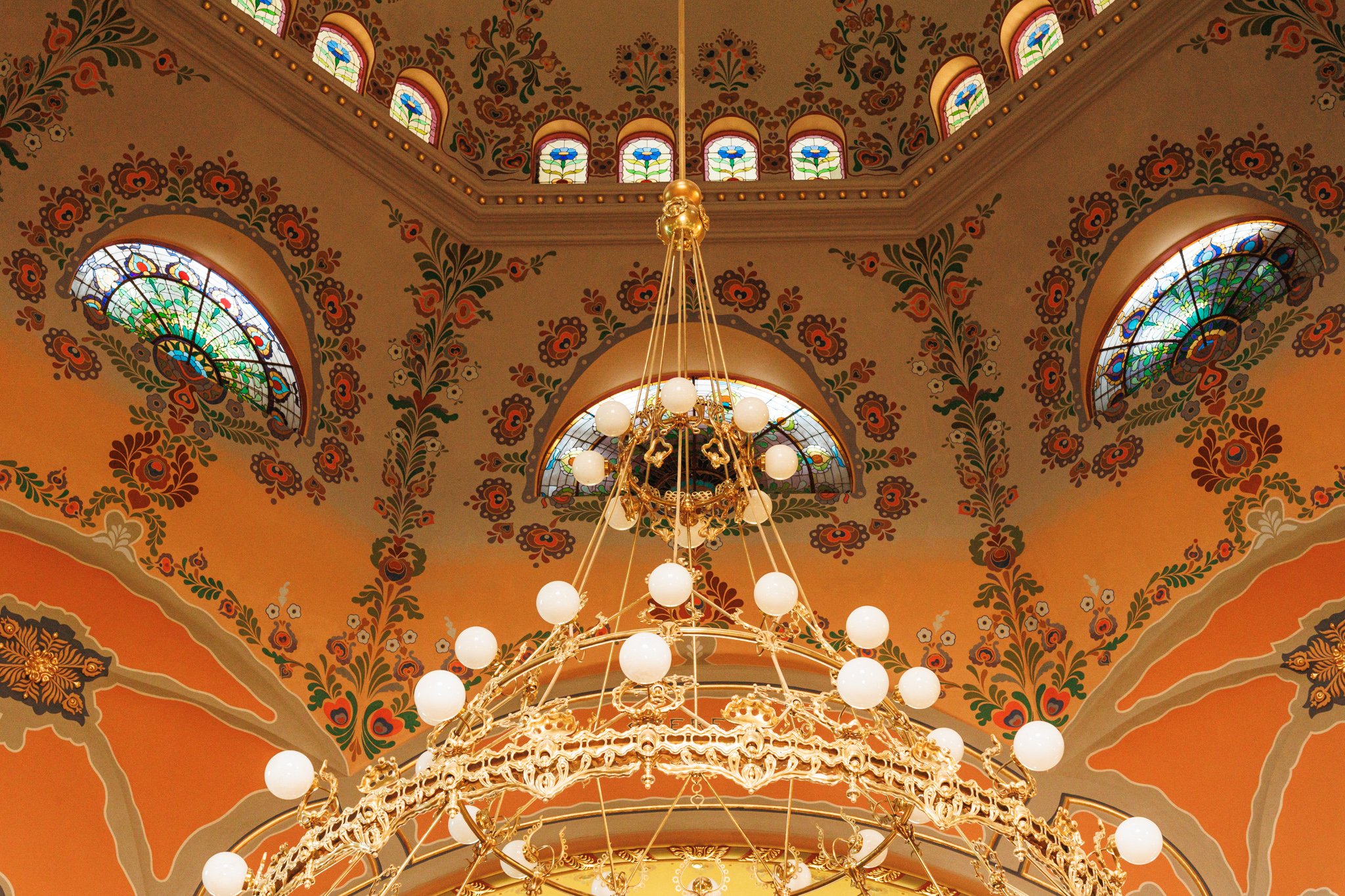
Inside, the building opens into a single tall space. It was meant to recall the tent in which the Israelites carried the Torah during their forty years in the wilderness.
The tent is held up by steel. Eight columns, joined by girders, carry an octagonal wall and a dome of thin concrete laid over wire mesh. Plaster hides the metal. What you notice instead is how little stands in the way. There was room for about 850 men on the ground floor and 550 women in the gallery above.
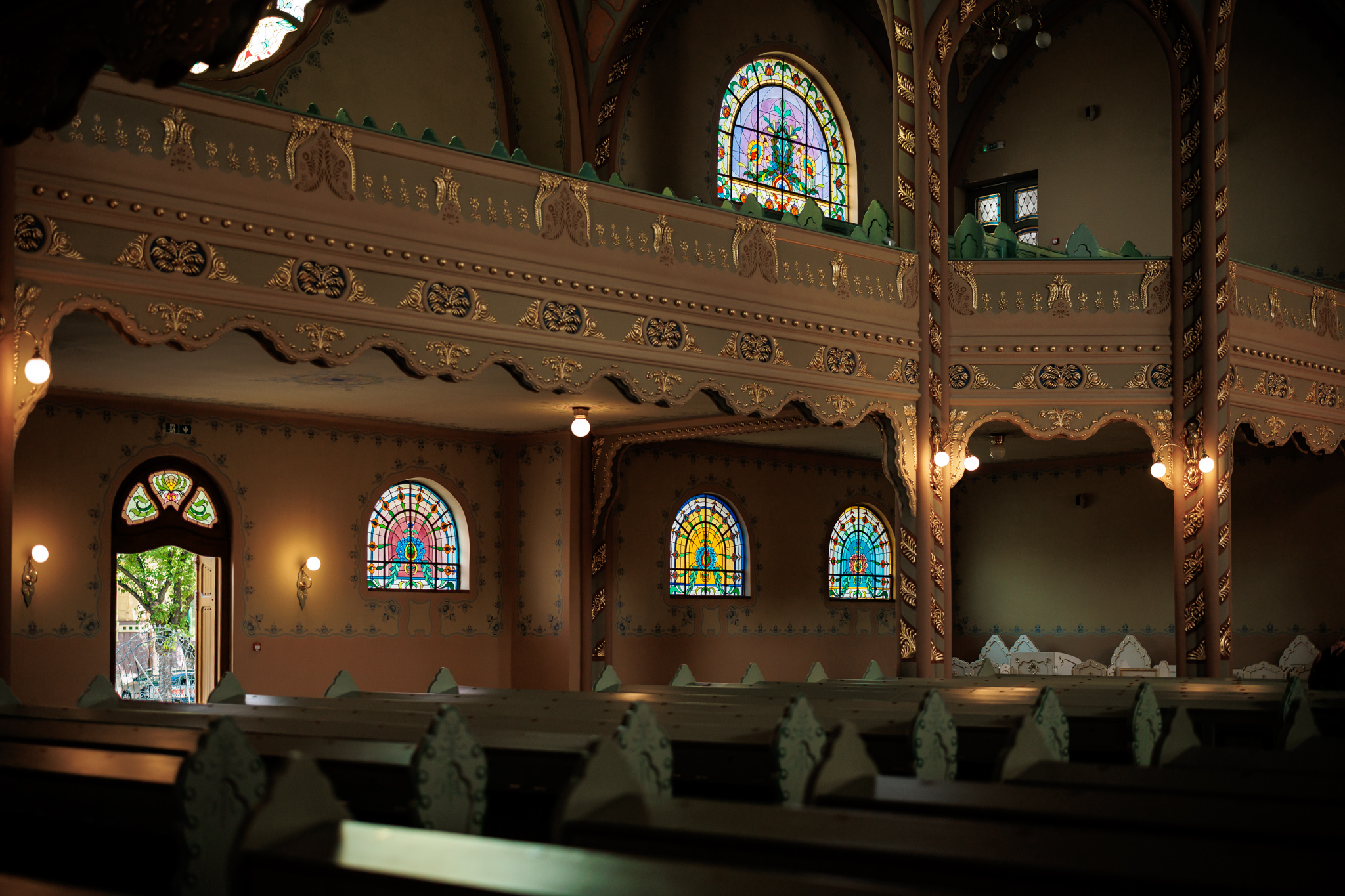
Jakab described the aim as a light, bright temple in lively colours, in contrast to the gloomy intimacy of Gothic churches. The churches of Subotica were not asked for comment.
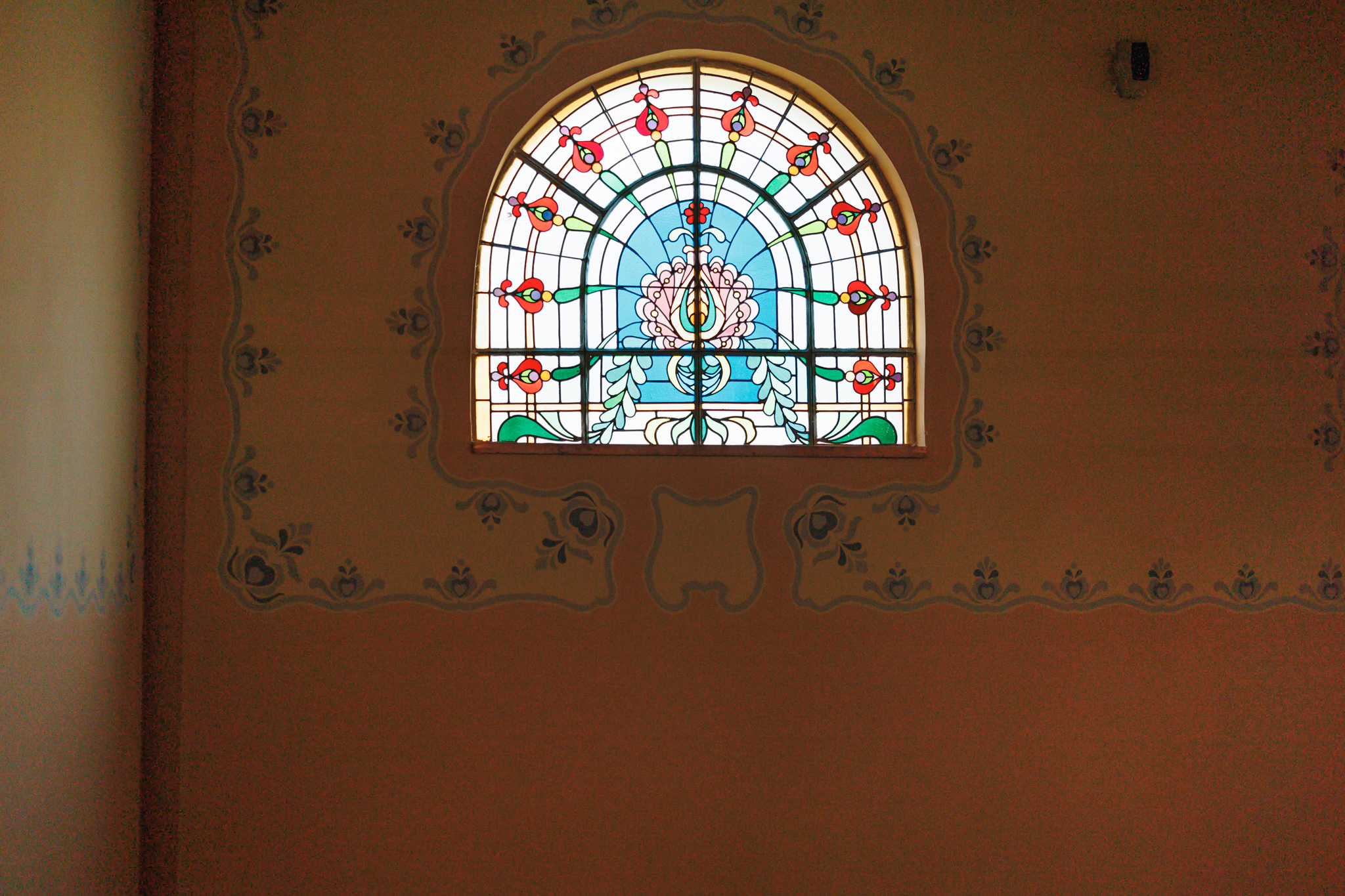
Tulips, poppies, hearts and peacock feathers climb the walls and fill the dome, as if the embroidery of the Hungarian countryside had been enlarged to the size of a building. The stained glass came from Miksa Róth’s workshop in Budapest.
In two languages
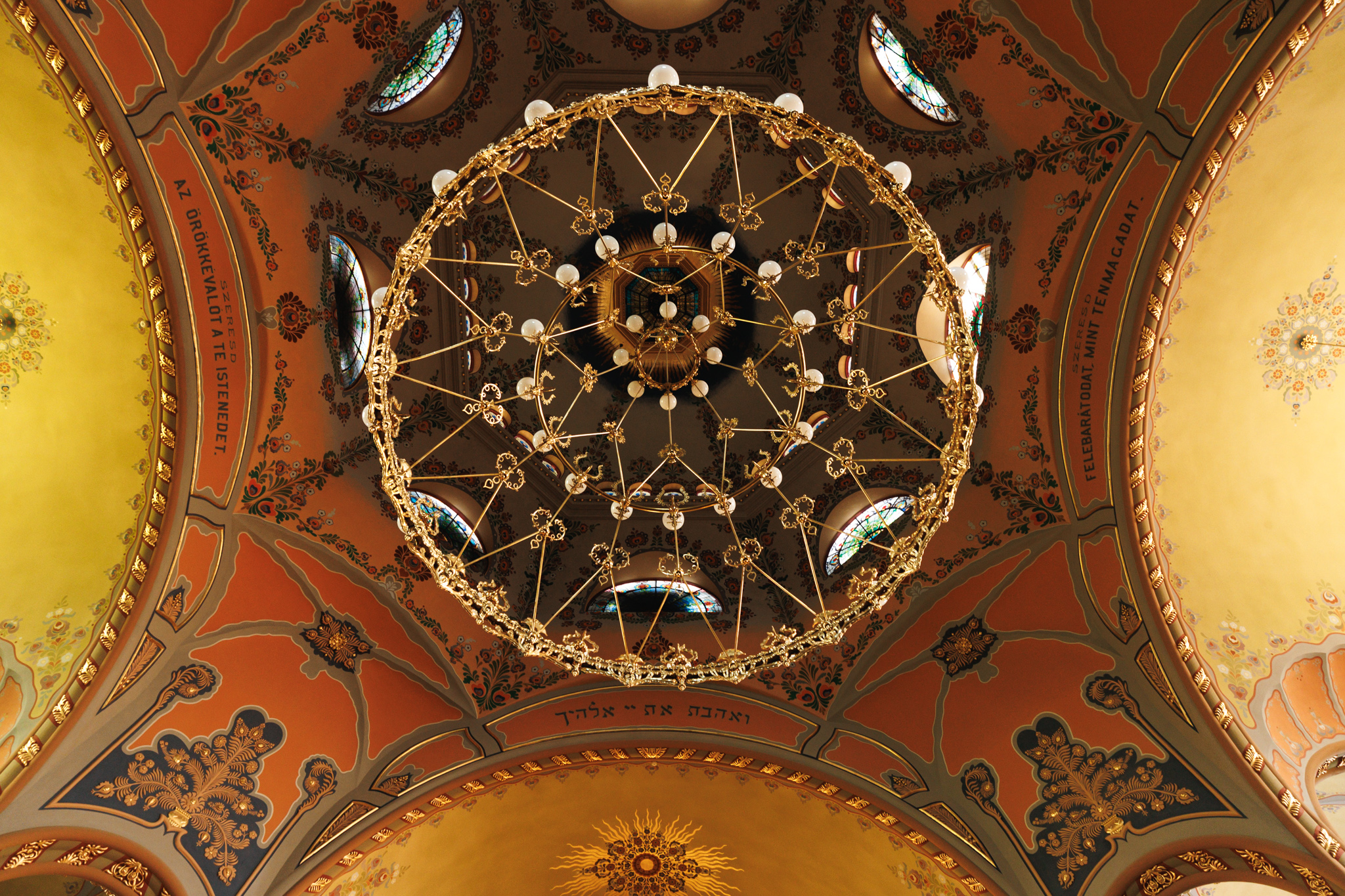
Words run around the base of the dome. Some are in Hebrew. Others are in Hungarian: Szeresd az Örökkévalót, a te Istenedet, “Love the Eternal, your God”, and Szeresd felebarátodat, mint tenmagadat, “Love your neighbour as yourself”.
Both commandments come from the Torah. Hungarian was the language of the country Subotica then belonged to, and of much of the congregation. The community had built its house of prayer in a local style and filled it with local flowers. Then it put the commandment about neighbours in the dome.
Anyone who looked up could read it.
Silence, then a stage
Before the Second World War, about 4,900 Jews lived in Subotica. In 1941, Hungary annexed the region. In May 1944, the city’s Jews were forced into a ghetto near the railway station. On 16 June, they were put on freight wagons to a camp at Bácsalmás, in present-day Hungary. From there, most were sent to Auschwitz.
After the war, the survivors could not maintain a building of this size. In the late 1970s, it passed to the city. From 1985 to 1992, it was used as a theatre. Some productions brought animals inside. Over the years, badly installed heating cables also caused fires.
Restoration had begun in the 1970s. It went on, in stops and starts, for about forty years. The interior, the last major stage, was paid for largely by the Hungarian government and finished at the end of 2017. In May 2018, the synagogue was rededicated, and Torah scrolls were placed in the ark again.
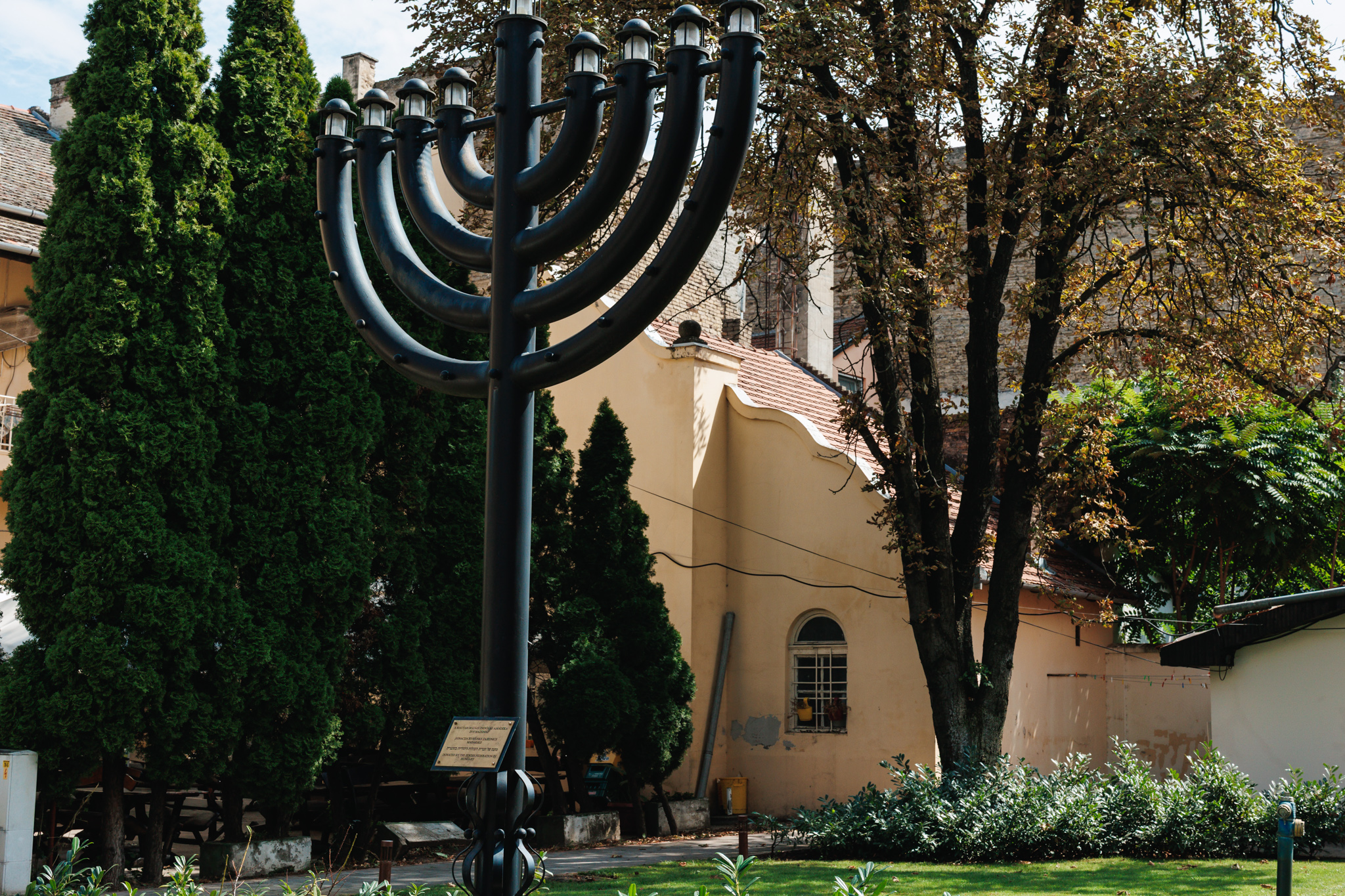
For the occasion, the Federation of Hungarian Jewish Communities gave a three-metre hanukkiah, the nine-branched candelabrum lit at Hanukkah. It stands in the garden.
Terms of entry
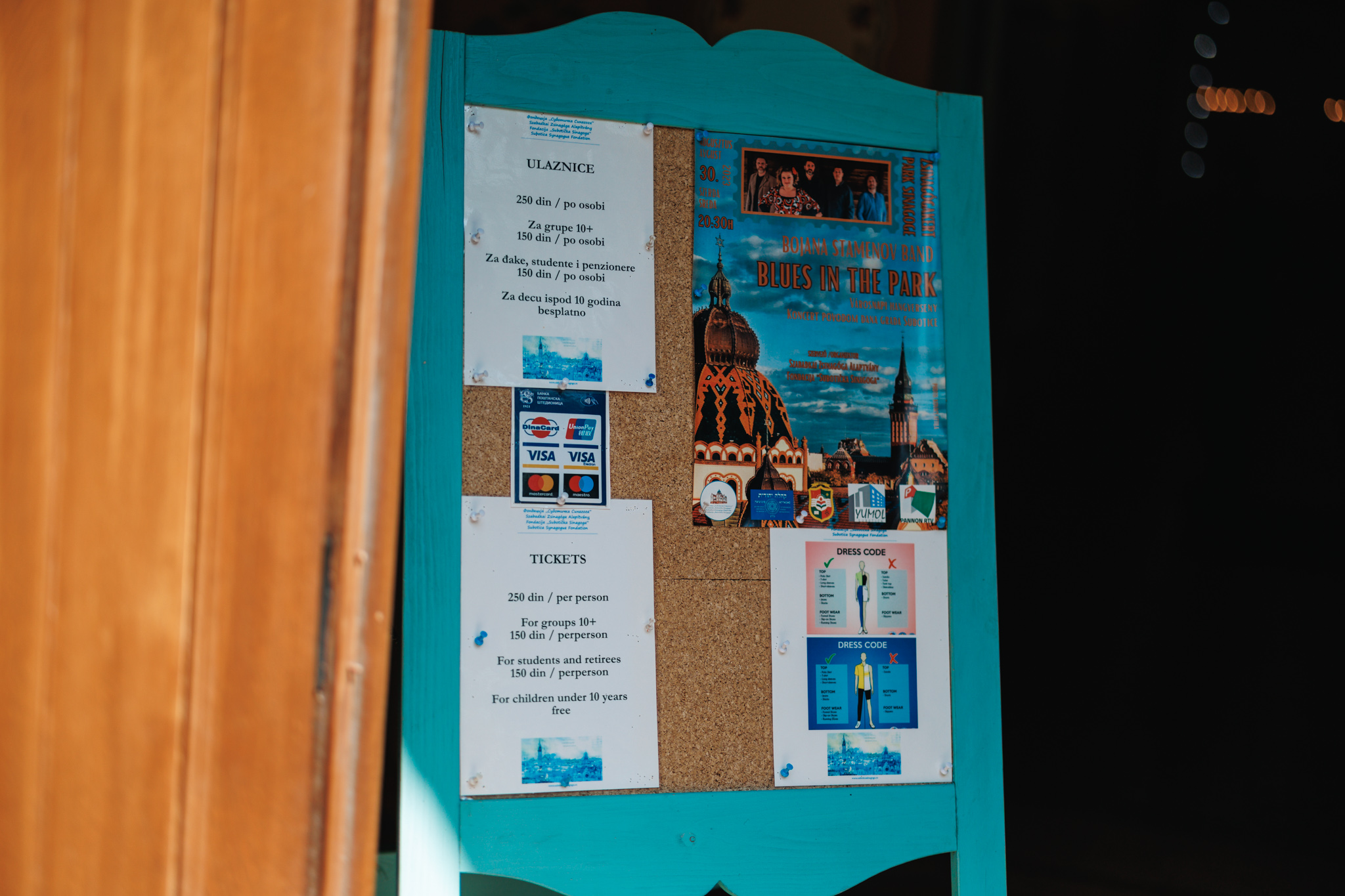
By the entrance, a turquoise noticeboard dealt with the present. Tickets were 250 dinars. A dress code ruled out shorts, tank tops and slippers. Each of its illustrated figures wore half an acceptable outfit and half an unacceptable one, so visitors could see both outcomes at once.
It was a hot day at the end of August. The building’s answer to the heat stood on the floor in front of the ark: one black electric fan.
A poster announced a blues concert in the synagogue garden that evening, for Subotica’s City Day. It showed the synagogue’s dome and the City Hall tower side by side: two Komor and Jakab buildings under one sky.
The iron fence around the synagogue is worked in a pattern of hearts. I had taken my first look at the building through it.
Above the benches, the dome still says the same thing in two languages.
The advice has not changed. It has more readers again.
Visit this place
Location
Subotica Synagogue / Суботичка синагога
On Jakab and Komor Square in central Subotica
Trg Jakaba i Komora 6, 24000 Subotica, Serbia
Practical Information
- Hours
- Tuesday–Friday 10:00–18:00; Saturday–Sunday 10:00–14:00
- Admission
- 250 dinars; groups of 10 or more, students and retirees 150 dinars; children under 10 free
- Visitor note
- A dress code applies. At the time of my visit, the notice at the entrance ruled out shorts, tank tops and slippers. The synagogue also hosts concerts and events; check the programme before planning around them.
- Official website
- “Subotica Synagogue” Foundation
Information last checked: September 28, 2026 (Hours and admission, Foundation website)
Conversation
Comments
Review pending commentsComments are reviewed before appearing. The internet already contains enough unattended surprises.
Loading comments…
Leave a comment