St. Mark’s Church: Medieval, as Specified
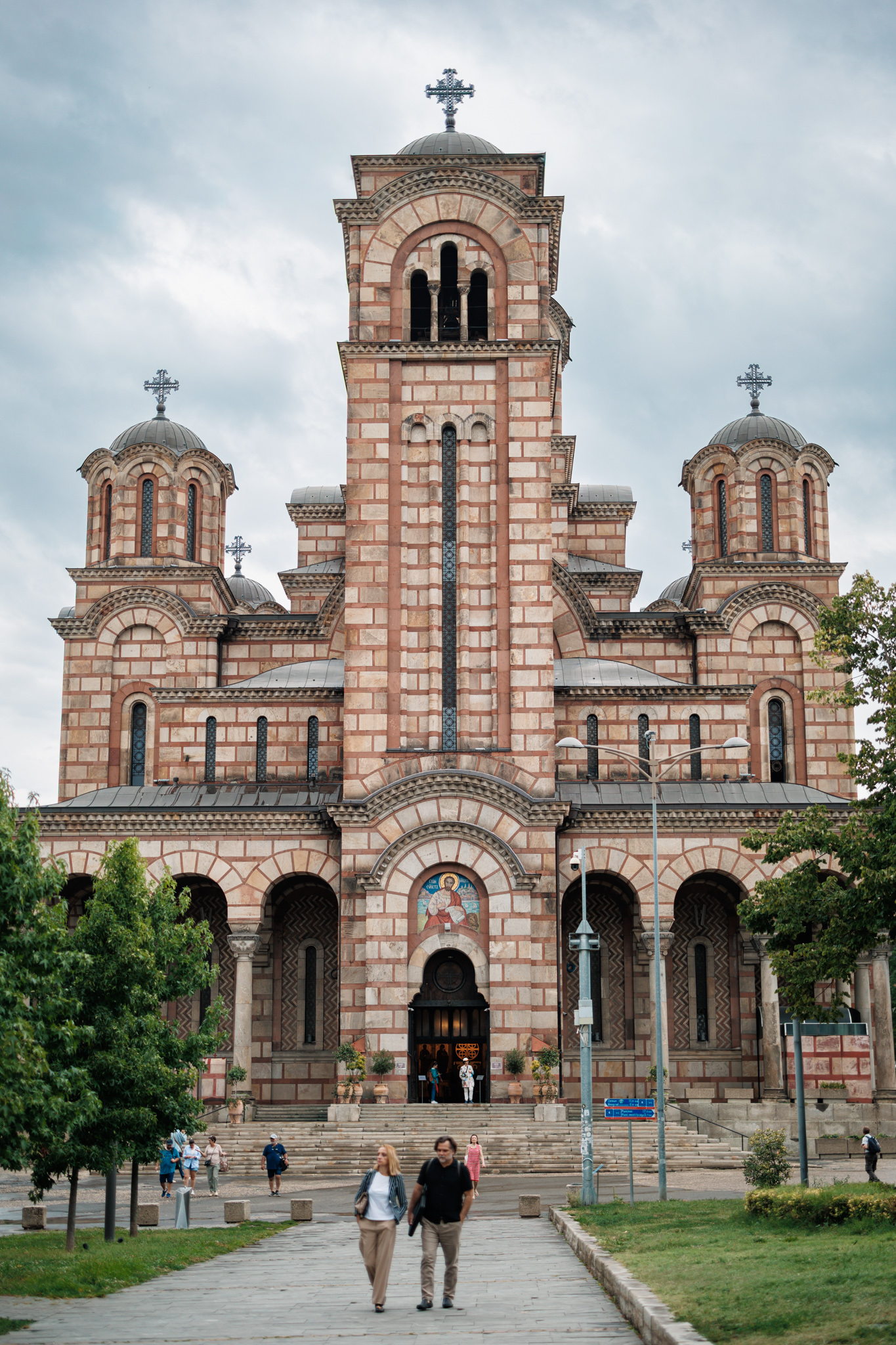
In late 1928, a competition was announced for a new church in Belgrade’s Tašmajdan. The brief was quite specific about the style.
“Old Byzantine, free, but most similar to the church of Gračanica Monastery.”
Gračanica was built in the fourteenth century. The brothers Petar and Branko Krstić won, and work on St. Mark’s began in 1931.
Stone on the outside
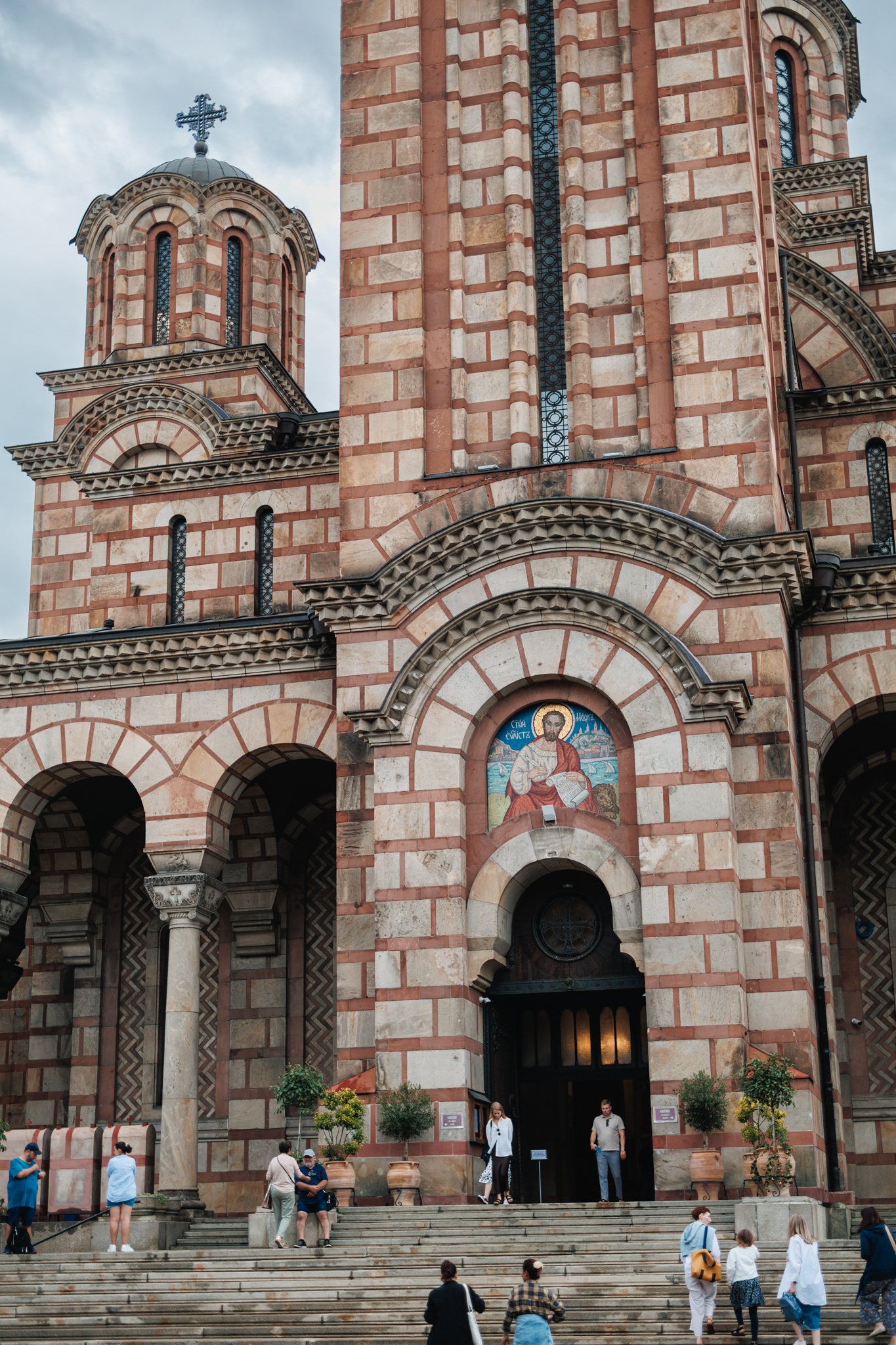
From a distance, the walls look like red brick laid between pale stone. They are, in fact, two kinds of stone: pale sandstone from Belovode, near Kruševac, and red stone from Grze, near Paraćin. Arranged in bands and blocks, they imitate the medieval way of building in brick and stone.
Behind the stone, the structure is reinforced concrete.
The park, incidentally, is named after stone. Tašmajdan comes from the Turkish words for “stone” and “mine”; there was once a quarry here. The church’s stone was brought in from central Serbia.
Above the entrance, St. Mark sits in a mosaic of blue and gold, pen in hand, with a lion beside him—his traditional symbol among the four evangelists. Veljko Stanojević made it in the early 1960s, more than two decades after the façade around it was finished.
The church next door
In the nineteenth century, Tašmajdan became a cemetery. A smaller St. Mark’s Church stood in it from 1836, slightly south of the present building. After King Alexander Obrenović and Queen Draga were killed in the 1903 coup, they were buried there.
The new church rose beside it through the 1930s.
For several years, the two St. Mark’s stood side by side.
In April 1941, German bombing set the old church on fire, and what remained of it was cleared away in 1942.
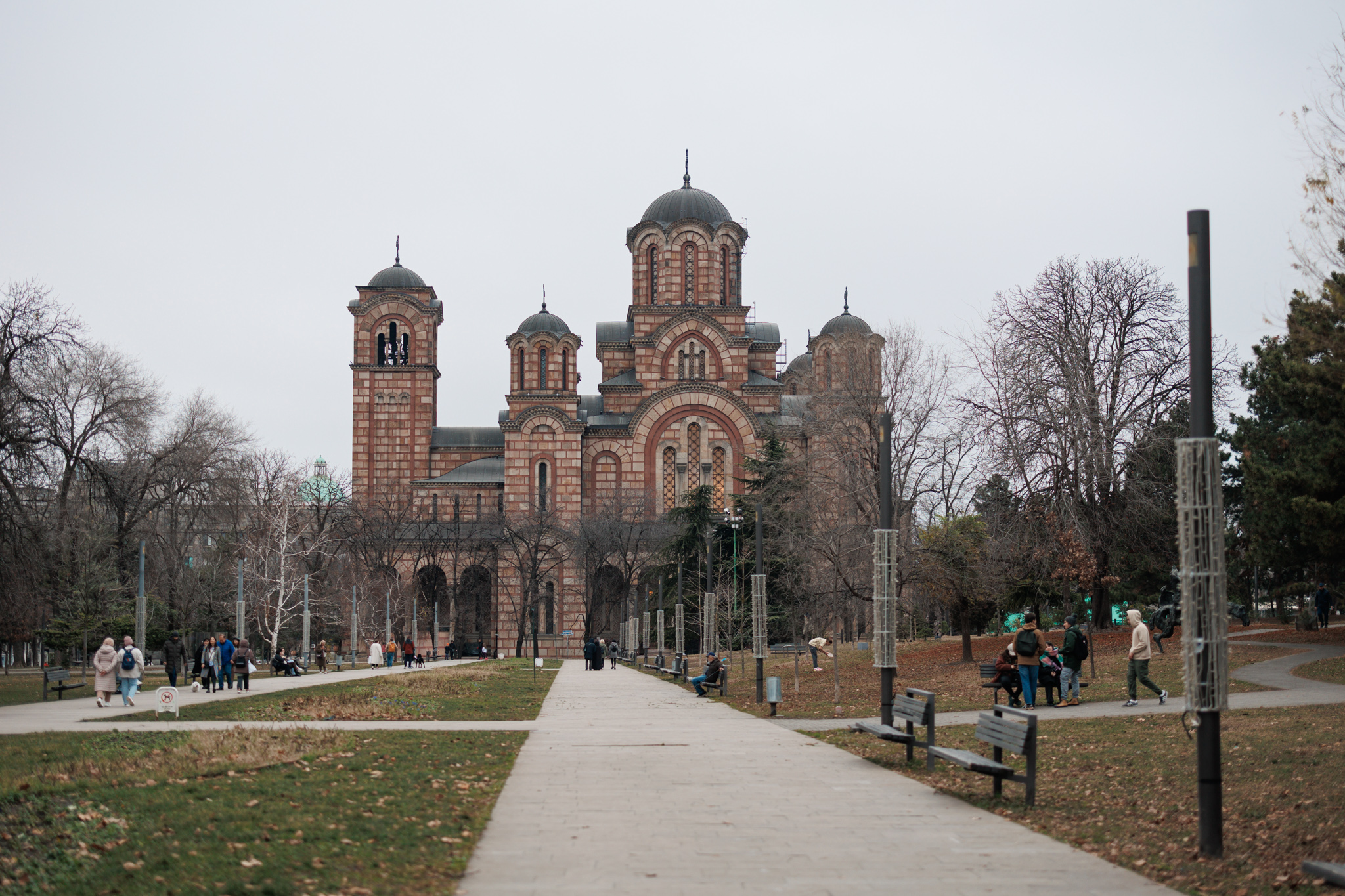
The war also halted work inside the new building, which was not consecrated until 1948. The cemetery, meanwhile, has long since become a park, with paths, benches and people walking between the trees.
When I came back on 7 January 2024—Christmas Day in the Serbian Orthodox calendar—the city streets were quiet. The church had a fair few people.
Residents from elsewhere
Inside, a sign said that photography was not allowed, so this part comes without pictures.
The marble iconostasis, the screen of icons between the congregation and the altar, dates from the 1990s. On the right as I went in, along the south wall, was the marble tomb of Stefan Dušan, Serbia’s fourteenth-century emperor. His remains were brought here from the Monastery of the Holy Archangels near Prizren. On the north side lies Patriarch German, a twentieth-century head of the Serbian Orthodox Church.
Below, in the crypt, are King Alexander and Queen Draga, who were first buried in the old church next door.
Back in the park, another figure is noticeably behind the times. A knight sits upright on a gaunt horse whose head droops low in front of it, a long lance held straight up beside him. This is Don Quixote, by Jovan Soldatović.
Don Quixote read so many books of chivalry that he put on his ancestors’ old armour and set out as a knight, long after knights had gone out of fashion.
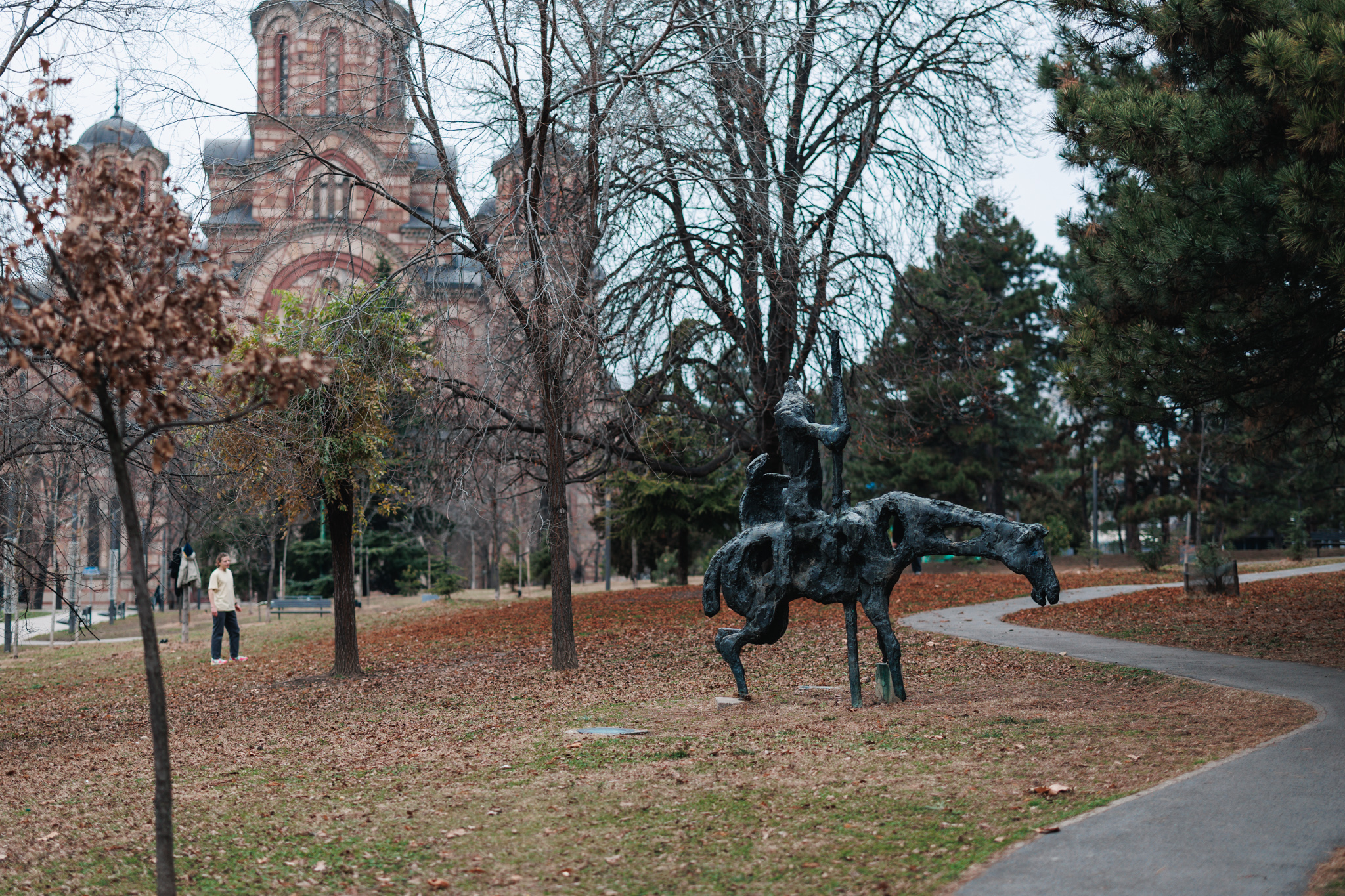
In Tašmajdan, he is not the only one dressed for an earlier century.
Visit this place
Location
St. Mark’s Church / Црква Светог Марка
In Tašmajdan Park, central Belgrade
Bulevar kralja Aleksandra 17, 11000 Belgrade, Serbia
Practical Information
- Opening hours
- Daily 07:00–19:00
- Services
- The church publishes its schedule of services on its website.
- Photography
- On my visit, a sign inside said photography was not allowed. Follow the signs and staff on site.
- Visitor note
- This is an active place of worship. Keep quiet inside and avoid disturbing services or prayer.
- Official website
- Church of St. Mark
Information last checked: October 6, 2026 (Opening hours and the published service schedule checked on the official church website; admission and access to the crypt not confirmed. The photography note records a sign seen on the author’s visit.)
Conversation
Comments
Review pending commentsComments are reviewed before appearing. The internet already contains enough unattended surprises.
Loading comments…
Leave a comment