Vietnamese Women’s Museum: She Drew 863 Mothers Before It Was Too Late
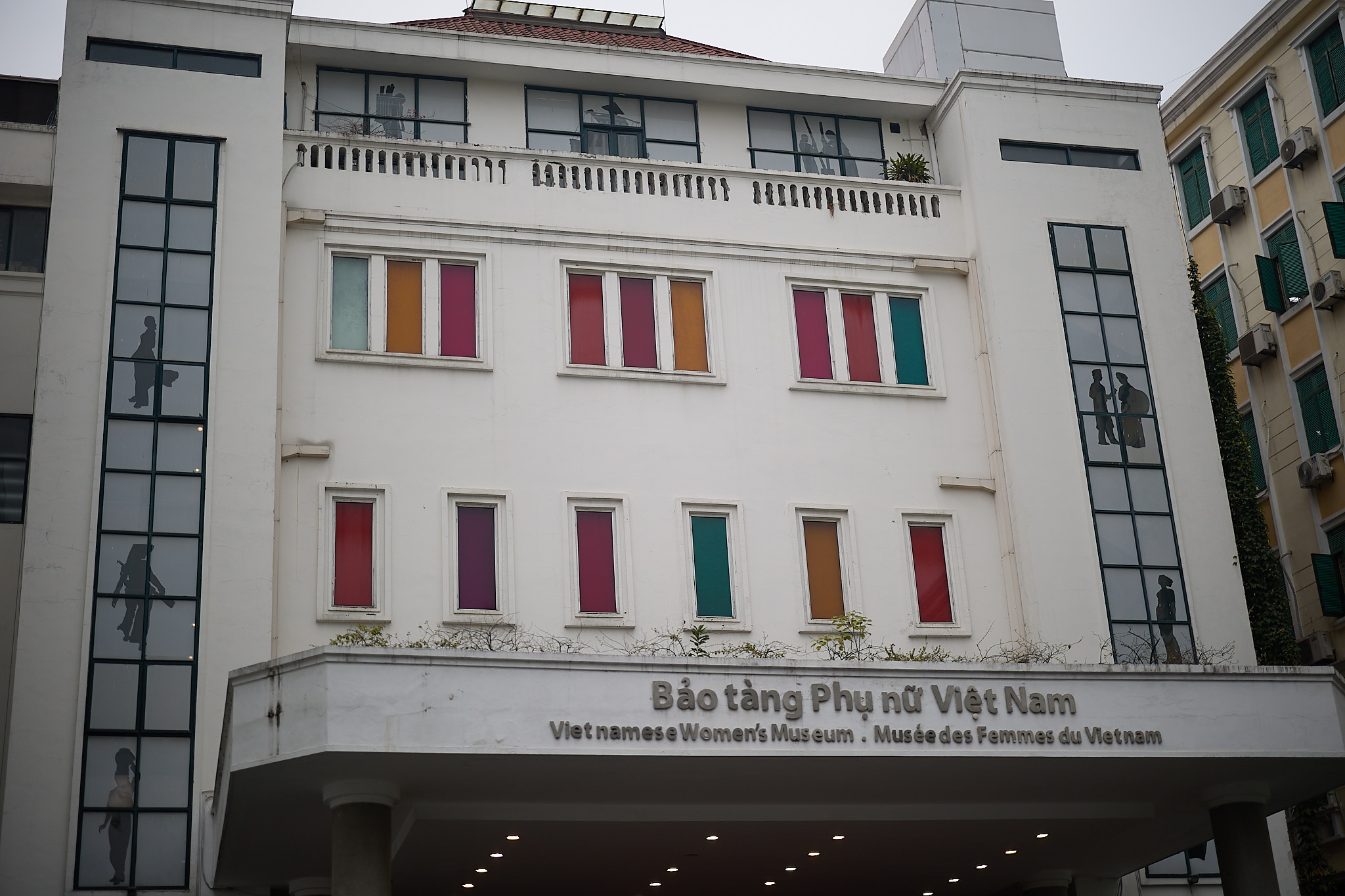
In the town of Trà Vinh, in the Mekong Delta, Võ Hồng Điều went to meetings of the Party committee with a white cloth hood over her head, for secrecy. It had two square holes for the eyes and none for the mouth.
She started wearing it in 1968, the year she was also involved in a protest at the town market, against higher market dues and against poor women being driven from their selling spots. Later she became general secretary of a union of labourers and small traders. She wore the hood until 1975. On the morning of 30 April that year, she and another woman led one wing of the uprising in Trà Vinh, as armed units and some twenty thousand people moved on the provincial governor’s residence.
The hood is now in Hanoi, in the history rooms of the Vietnamese Women’s Museum, on a low white stand in front of a red wall. The museum’s other two subjects are family and fashion.
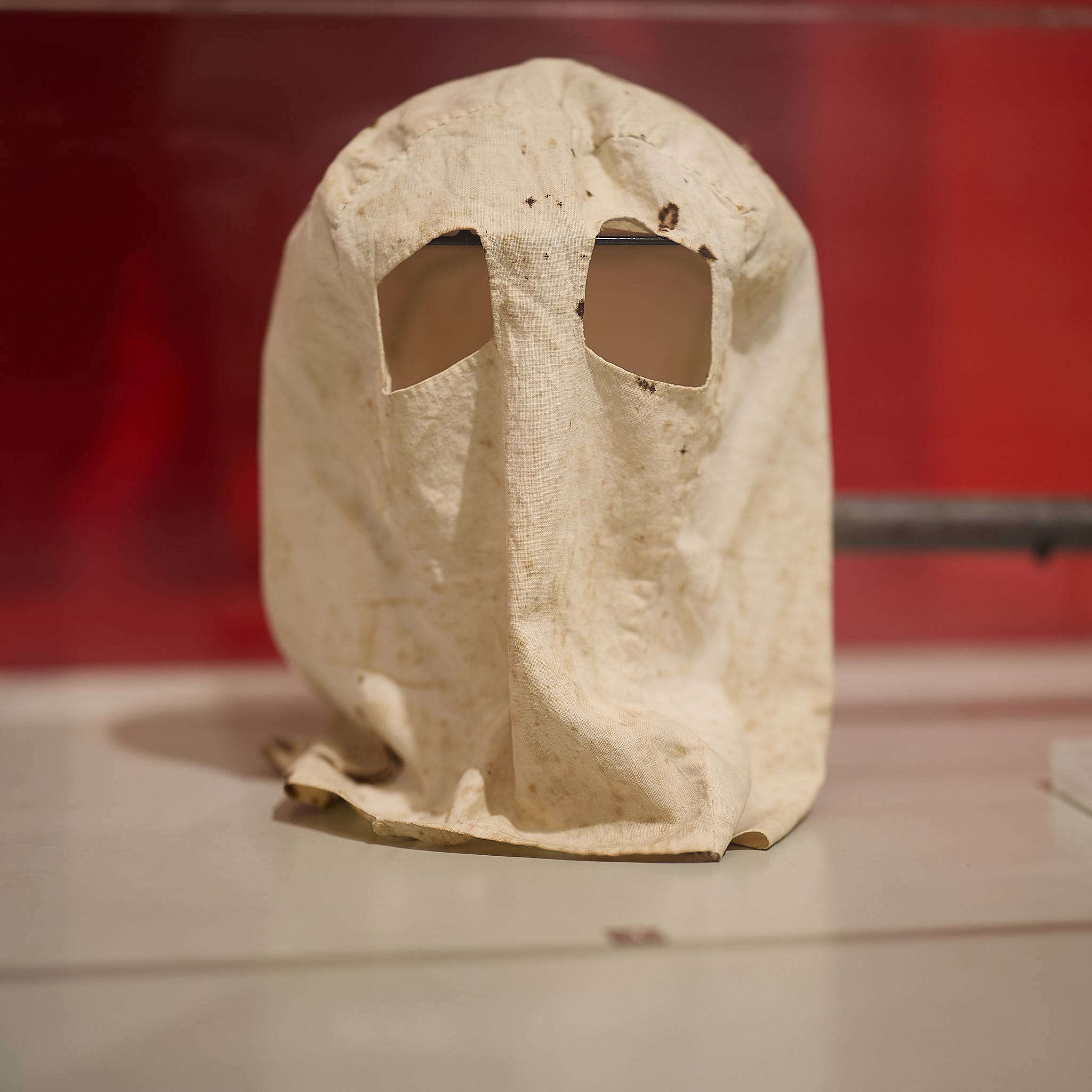
Mother Vietnam
In the round lobby on the ground floor stands a woman in gold, in a long, swirling dress, holding a small boy up at her shoulder. Her title is Mẹ Việt Nam, Mother Vietnam: no name of her own, only the country’s. Nguyễn Phú Cường’s statue won first prize in a sculpture competition the museum ran with the Ho Chi Minh City Fine Arts Association in 1995, and has since become the museum’s emblem.
Hats, cloth and something with a tail
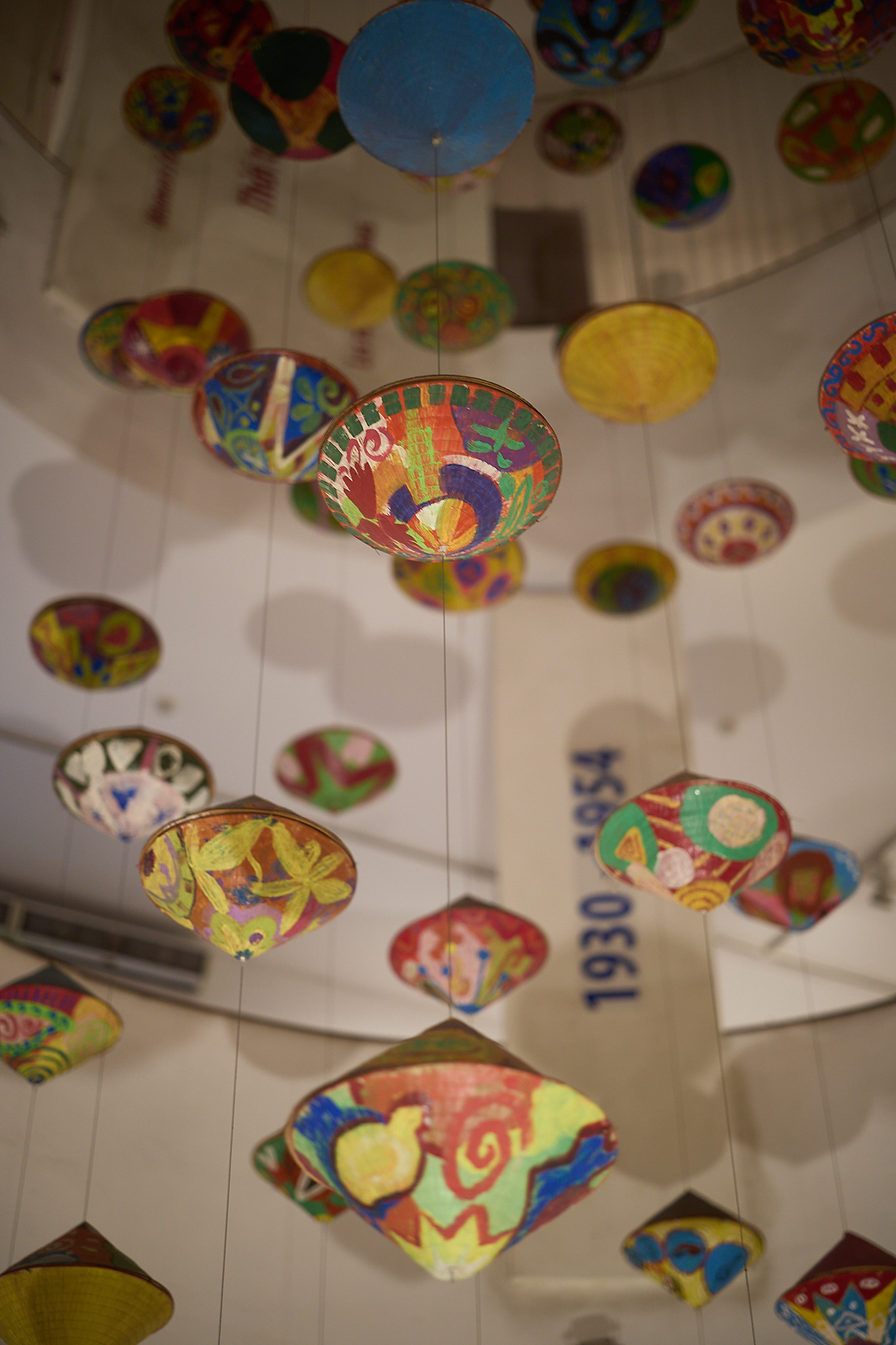
In the atrium, conical hats hang on long wires, dozens of them, each painted differently: spirals, petals, stripes, blocks of colour.
The family rooms describe brides who made their own wedding clothes and presents for the groom’s family: fabrics, blankets, pillows. They also set patrilineal societies beside matrilineal ones, such as the Ede, Mnong and Jarai, where a husband usually lives in his wife’s home, the children take their mother’s name and the daughters inherit, the youngest most privileged of all.
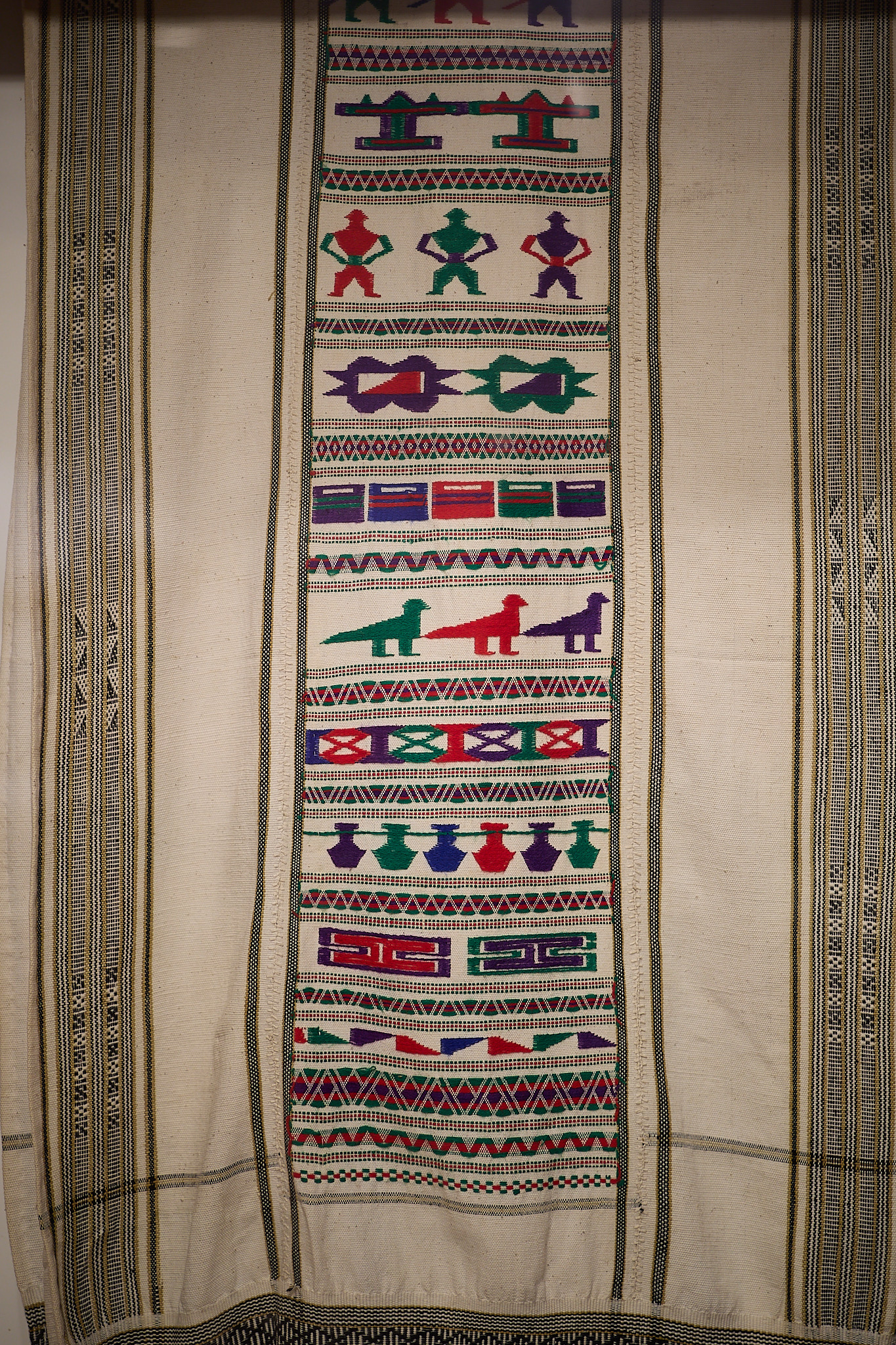
One length of cloth on display is patterned in bands of red, green and purple: diamonds, zigzags, a row of what look like pots, three people with their hands on their hips. In the middle, three animals walk nose to tail, with small heads, raised backs and long, pointed tails. They look like dinosaurs. I doubt they are.
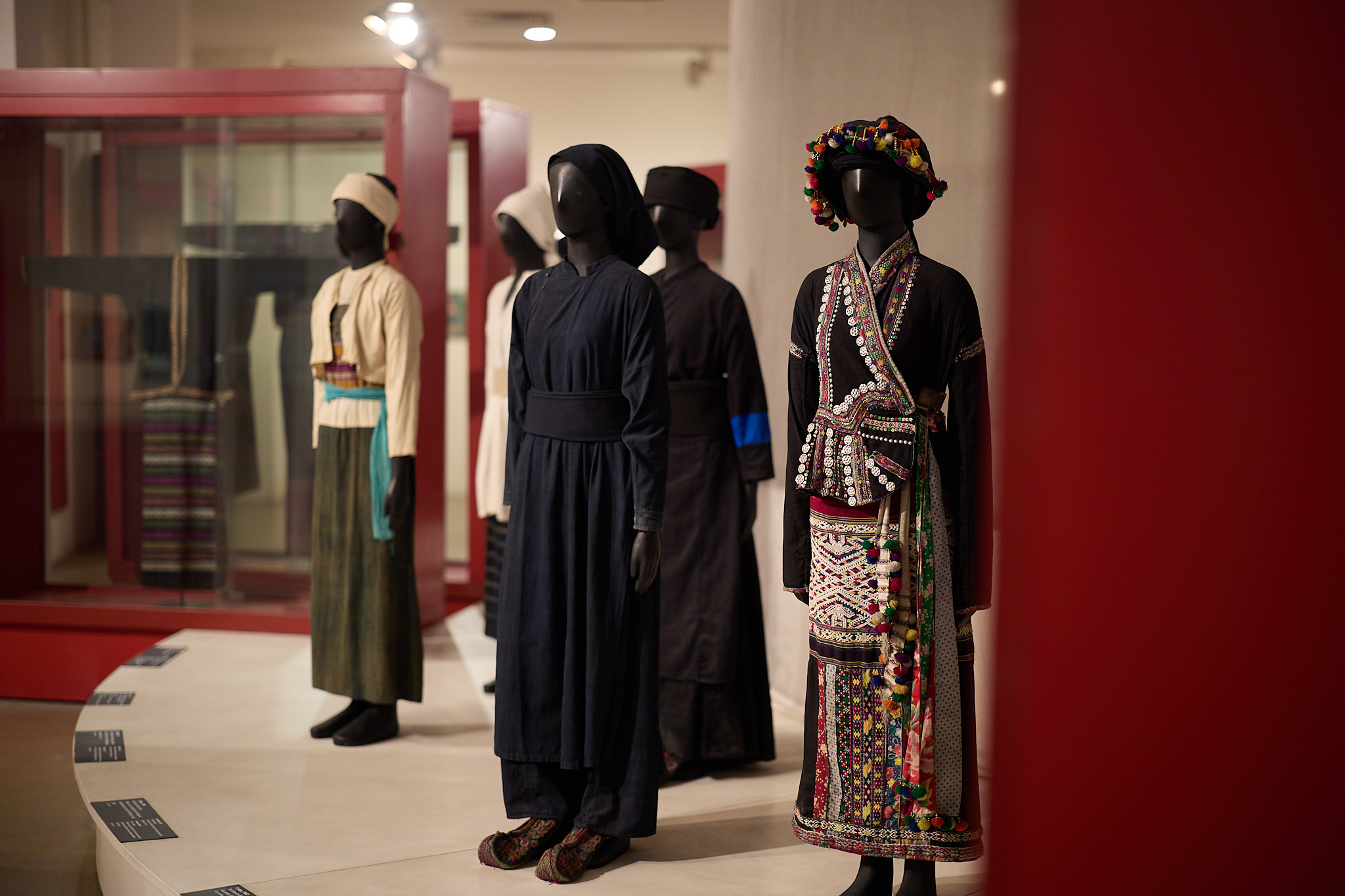
Clothes, it turns out, have evolved too, over time and through contact with others. Among the Hmong and Yao of the north, synthetic fabrics, wool and chemical dyes are now in wide use.
The goddesses
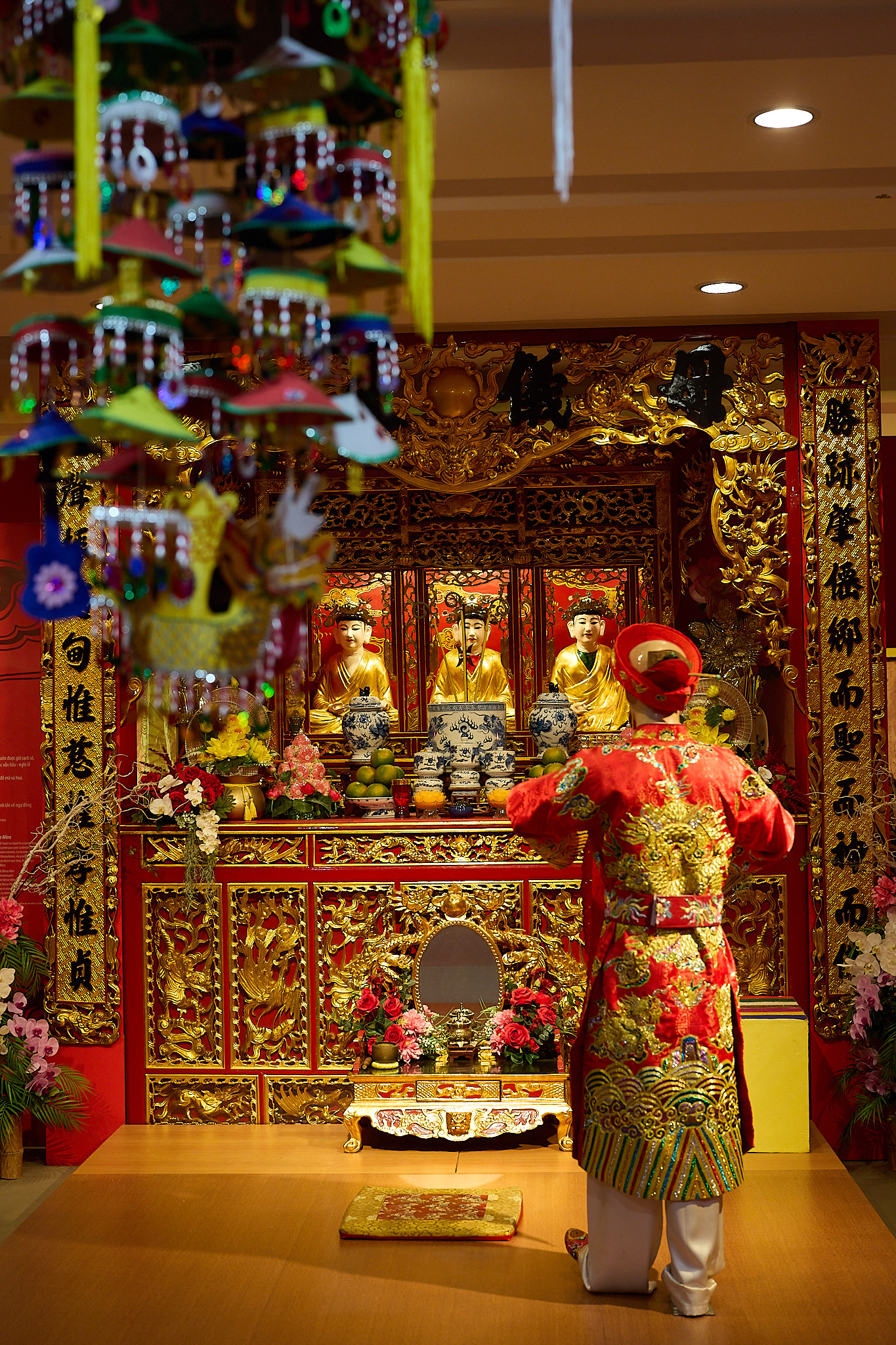
A replica of a Mother Goddess altar stands further on, red and gold up to the ceiling. Three figures are seated behind fruit and blue-and-white porcelain, and a mannequin in red and gold kneels in front. In a ritual, the medium’s costume shows which deity is present, while musicians called cung văn sing and play hát văn as an offering. The colours are a code: red for the Palace of Heaven, white for Water, yellow for Earth, green for Mountains and Forests.
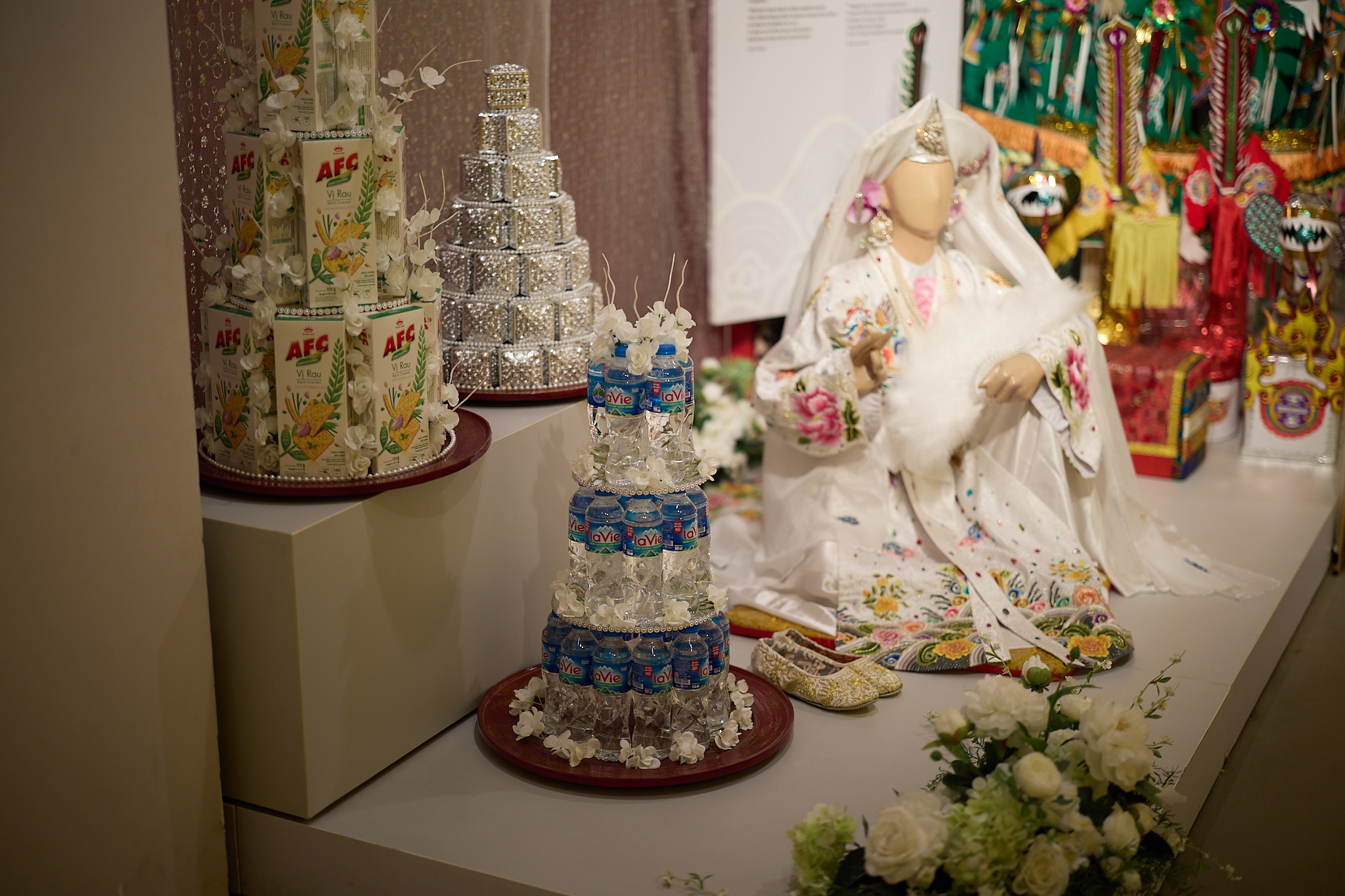
Another figure sits in white, holding a feather fan. The offerings beside it are crackers and water: boxes of AFC crackers, vegetable flavour, stacked in tiers, and bottles of LaVie stacked the same way, both trimmed with white flowers.
White is the colour of the Palace of Water. The water beside this figure is LaVie.
The Chaly
In another room, a small green Honda Chaly stands in front of a wall of photographs of elderly women, row after row, many in head-wraps, many with medals pinned on. The panel beside them reads, in three languages, Heroic Mothers of Vietnam. It is a state title. To hold it, a mother must have lost at least one child who died for the country.
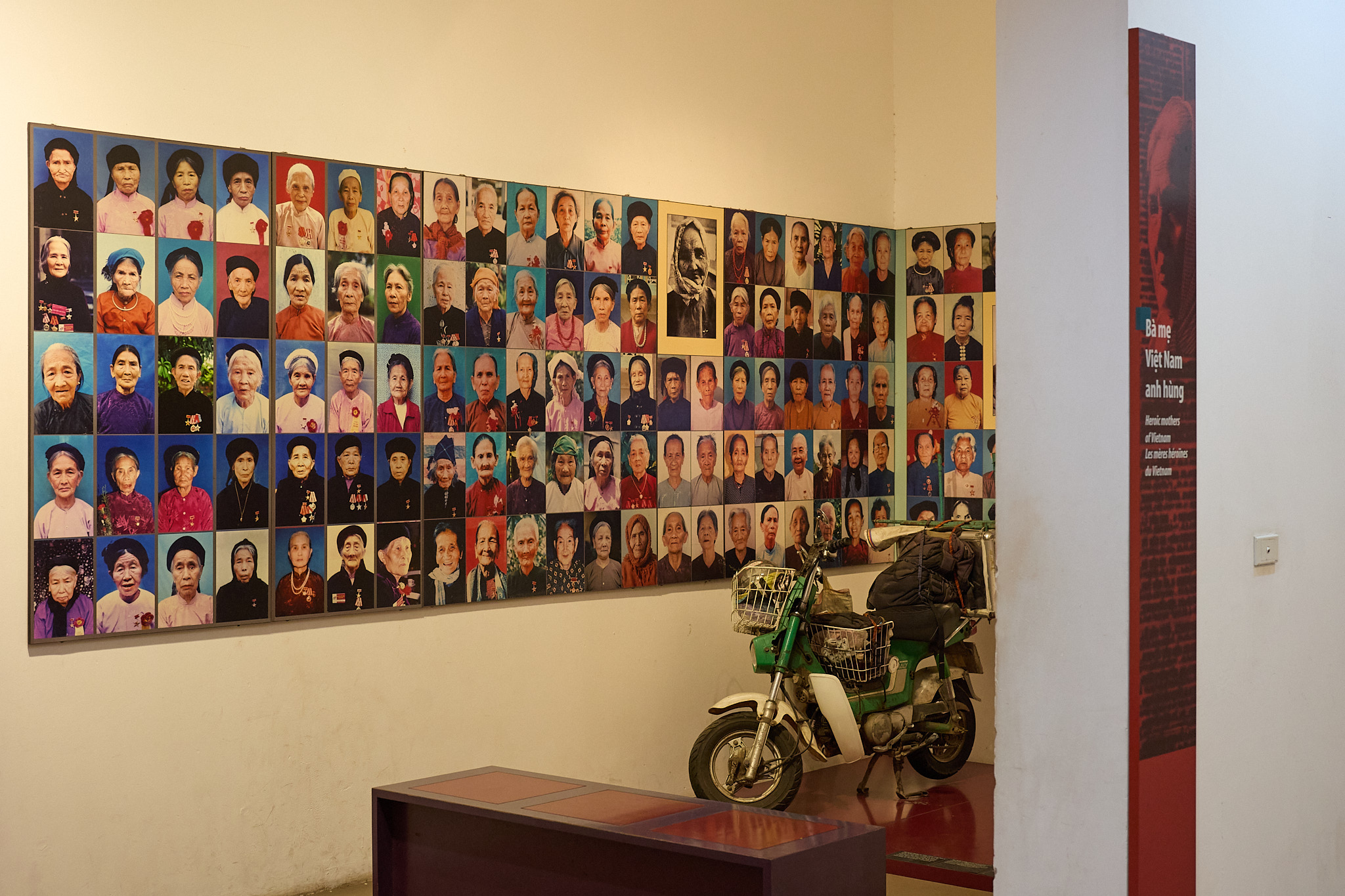
The bike belonged to the painter Đặng Ái Việt. In February 2010, in her early sixties, she set off on it from the South, heading north, to draw the country’s living Heroic Mothers. By June 2012 she had covered 35,600 kilometres and drawn 863 of them. That summer, the museum showed some of the drawings, and she gave it the Chaly. She kept drawing; by 2024 she had drawn more than three thousand portraits.
It was, she said, a race against time, to reach the mothers before it was too late. She did not always win it. One mother died a week after sitting for her. Another had only just been drawn when the news of her death caught up with the painter, one district down the road. Others died while she was still on her way to them.
In Lào Cai, on the northern border, she arrived to find that the province’s last Heroic Mother was already gone.
Visit this place
Location
Vietnamese Women's Museum (Bảo tàng Phụ nữ Việt Nam)
On Lý Thường Kiệt Street in central Hanoi
36 Lý Thường Kiệt, Hanoi, Vietnam
Practical Information
- Opening hours
- Daily, 8:00–17:00
- Admission
- 40,000 VND for adults; 10,000 VND for children aged 6–16
- Audio guide
- Available in Vietnamese, English, French, Japanese and Korean
- Official website
- Visitor information
Information last checked: November 3, 2026 (Opening hours and audio-guide languages checked against the official museum Visit page; admission against the Vietnam Ministry of Finance fee circular.)
Conversation
Comments
Review pending commentsComments are reviewed before appearing. The internet already contains enough unattended surprises.
Loading comments…
Leave a comment