Novi Sad’s Armenian Memorials: Skulls beside the Bus Stop
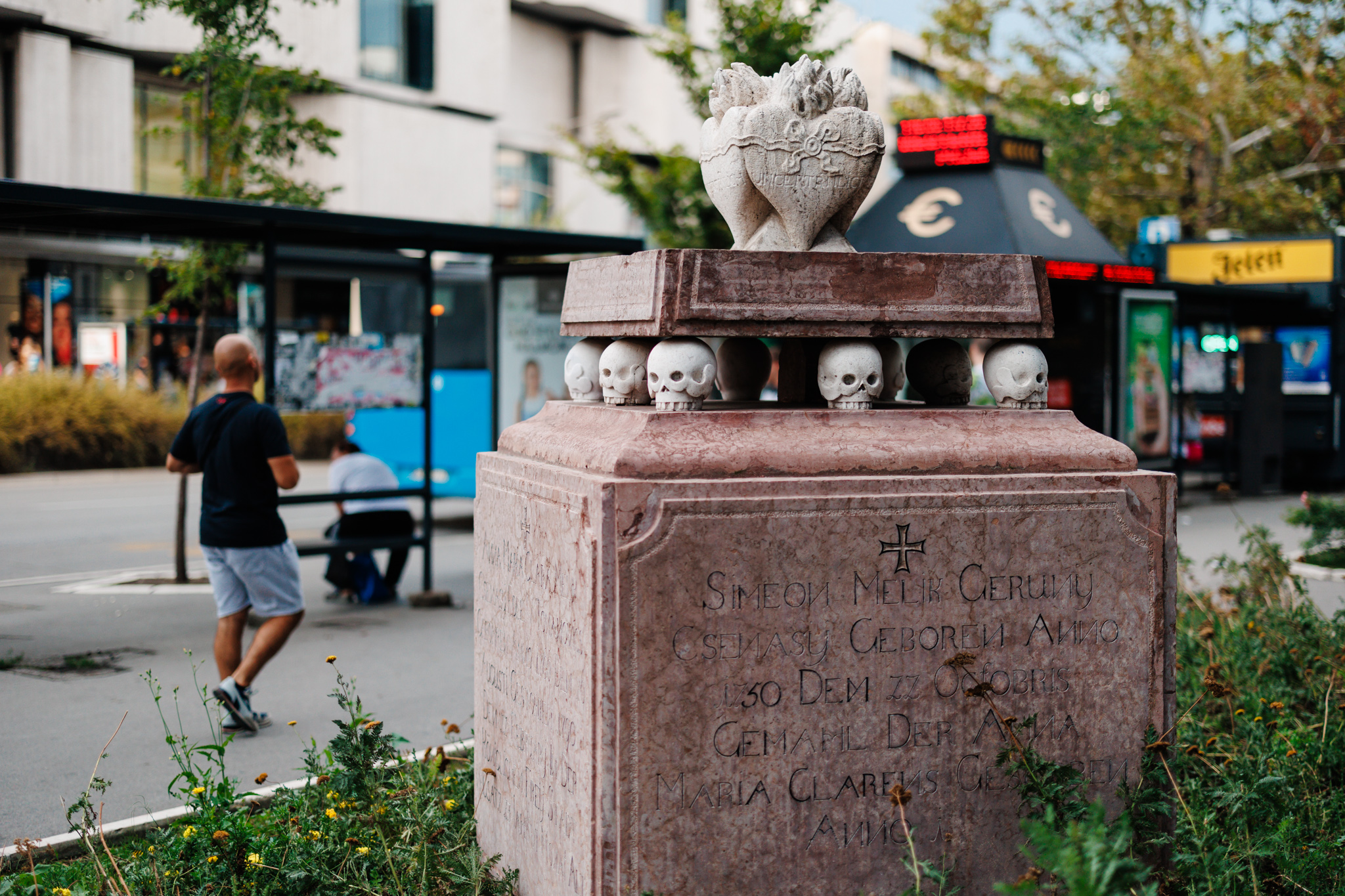
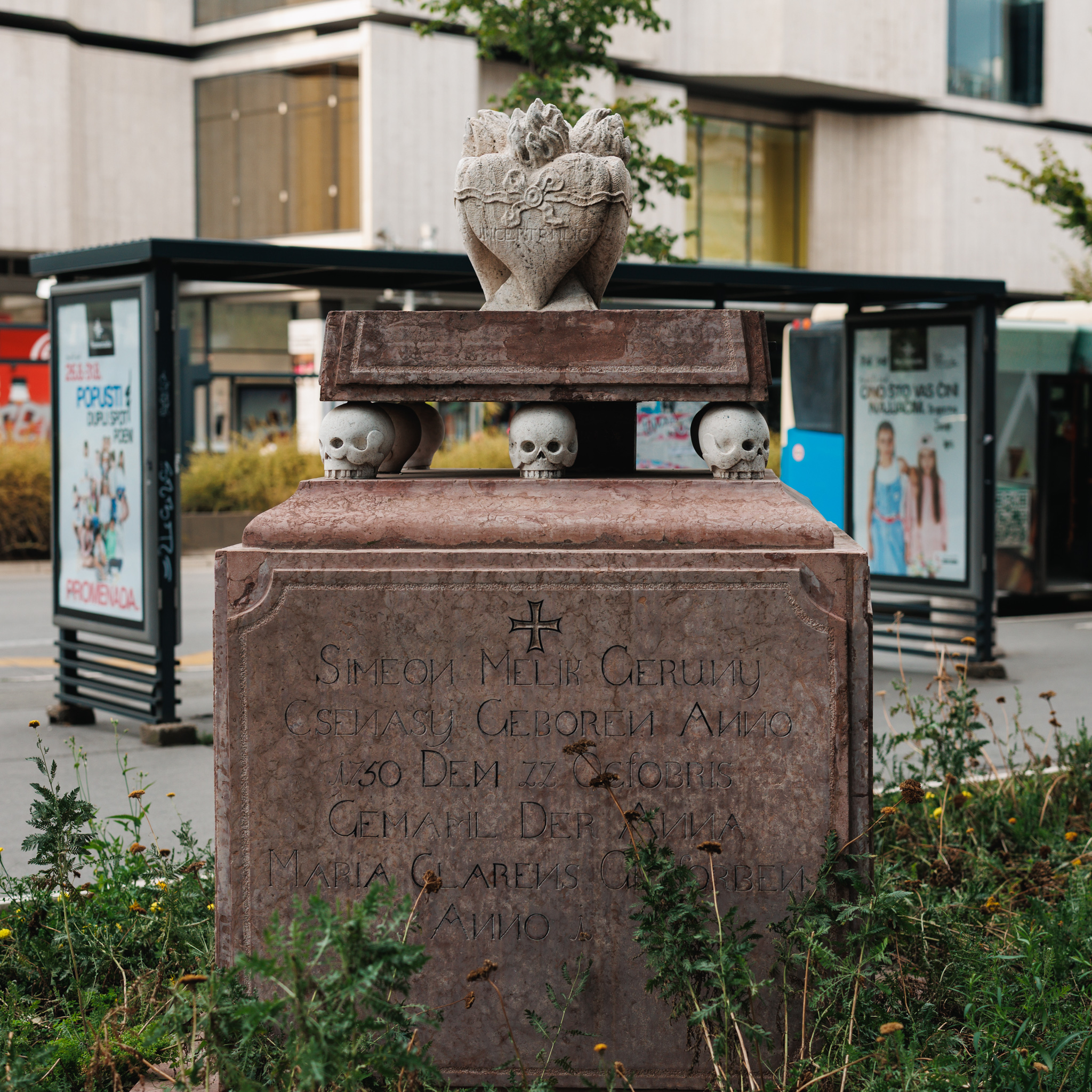
In central Novi Sad, a family tomb stands beside a bus stop, with a currency exchange just behind it. White stone skulls sit beneath a slab of pink marble, with intertwined hearts rising above them.
The surrounding street has made no particular effort to look like a graveyard.
This is the Tomanović–Čenazi family monument, erected in 1790. Up close, the skulls have neatly defined teeth and empty eye sockets, while carved flames rise from the hearts above. An inscription on the hearts means “inseparable.” For all the attention the skulls attract, the family gave the last word to affection.
A churchyard without a church
The setting makes more sense once you add a building that is no longer there. Armenians leaving Belgrade in 1739, when the city returned to Ottoman rule, established a small community in Novi Sad, with an Armenian Catholic church dedicated to St Gregory the Illuminator. The family monument stood in its churchyard. What looks like an unusually placed tomb once had entirely appropriate surroundings.
The main inscription on the tomb is in German, not Armenian. Without a school of their own, Armenian children in Novi Sad were taught in German, and some families adapted their surnames. By 1939, a single registered Armenian remained in the city.
The church was demolished in 1963 to make way for the boulevard; by then, the city had no registered Armenians at all. The monument survived, although survival has involved several moves. During more recent construction work it was removed and restored. It returned in 2019, about 15 metres from its earlier spot and a little closer to the bus stop. Shortly before, remains of the Čenazi family and other Armenians buried in the former churchyard had been placed in a concrete ossuary—a chamber for human bones—beneath it.
The skulls on top are carved. The bones beneath are real.
A cross-stone, seven names
A short distance away, another reddish stone rises from a small planted patch beside the pavement. Its rough outline encloses a densely carved scene of the Crucifixion, surrounded by figures, curling leaves and interlaced patterns. Behind it, a modern glass façade favours a much simpler approach to decoration.
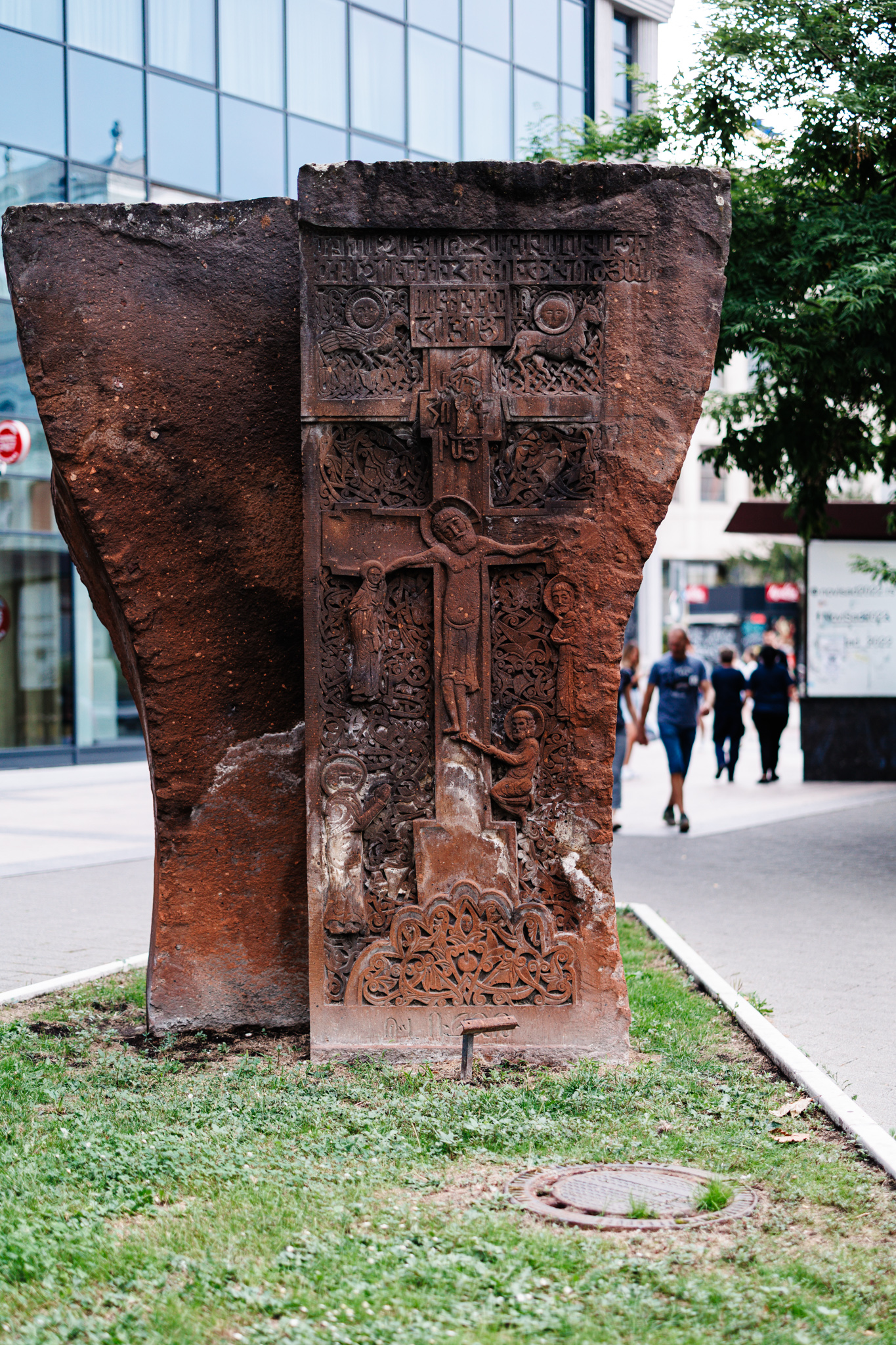
This is a khachkar, an Armenian “cross-stone.” These carved monuments can commemorate people, events or places, combining a cross with elaborate ornament. The form has a long history, but this example was installed in the early 1990s. Its traditional appearance gives little indication of how recent the story behind it is.
Walk around it and the carving gives way to a second stone, set facing the opposite direction. Seven names are inscribed on it. They belong to the crew of a Yugoslav transport aircraft that crashed near Yerevan on 12 December 1988 while carrying humanitarian aid to victims of the devastating earthquake in Armenia.
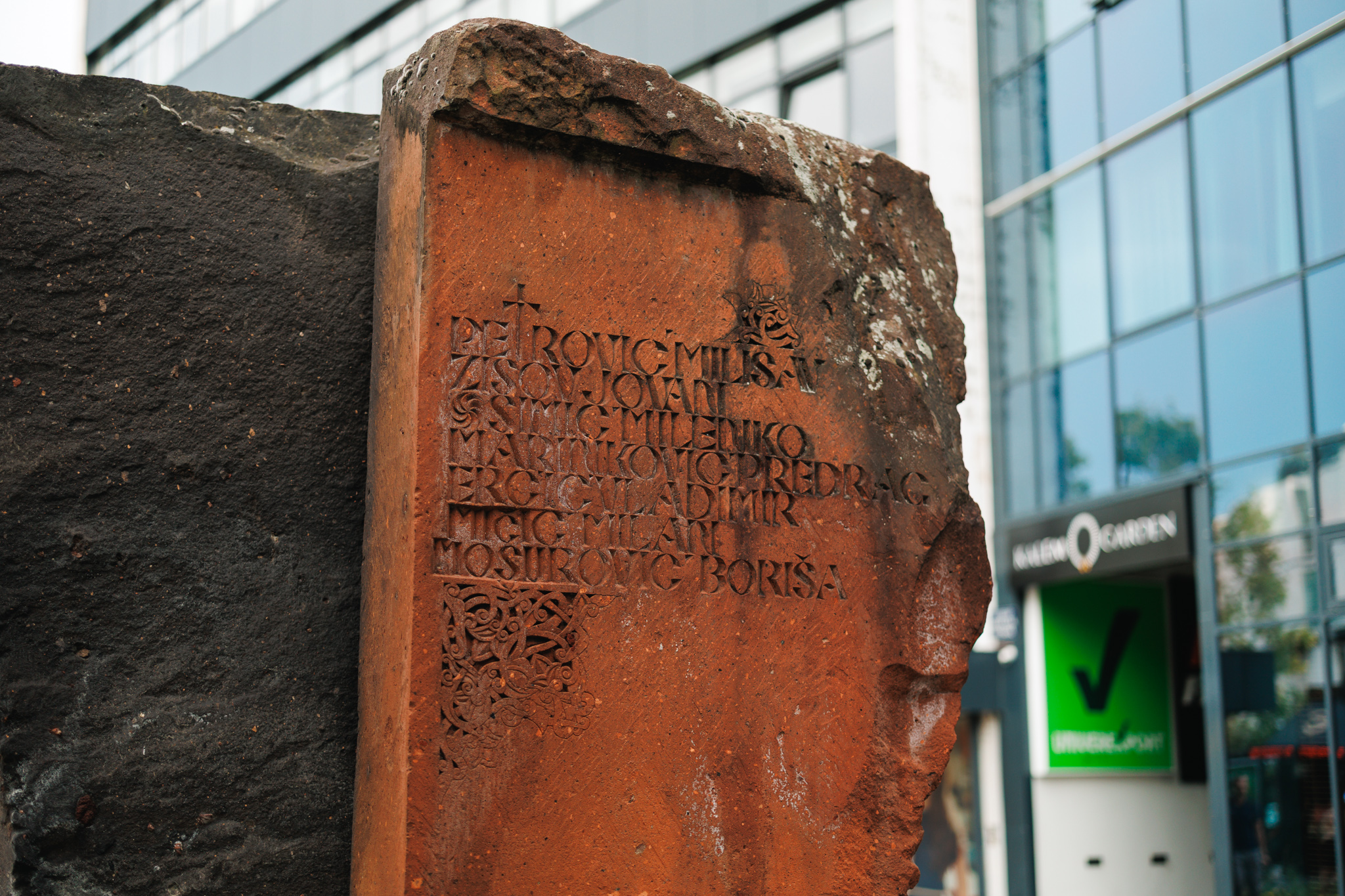
The khachkar commemorates those men, while also expressing gratitude to Novi Sad for sheltering Armenians in 1739. Its carved Crucifixion faces Petrovaradin Fortress, where the refugees from Belgrade first arrived. The family tomb preserves a trace of the people who made a home in the city; the cross-stone records a connection that continued after their church had gone.
Around both memorials, the street carries on with its own business: buses, currency exchange and people on their way elsewhere.
On this corner, names have proved more durable than buildings.
Visit this place
Location
Tomanović–Čenazi Family Monument and Armenian Khachkar / Надгробни споменик арменске породице Ченази и Хачкар у Новом Саду
On Bulevar Mihajla Pupina in central Novi Sad, near the site of the former Armenian church
Bulevar Mihajla Pupina, 21101 Novi Sad, Serbia
Practical Information
- Area
- Bulevar Mihajla Pupina, Novi Sad, Serbia
- Visitor note
- Both memorials can be viewed from the pavement. Leave the bus stop and planted area clear.
- Official information
- City of Novi Sad — Chenazy Family Gravestone
- Khachkar background
- Novi Sad City Assembly — Wreaths laid at the Novi Sad khachkar
Information last checked: September 18, 2026 (Memorial locations and historical background checked; no opening hours or admission information applies.)
Conversation
Comments
Review pending commentsComments are reviewed before appearing. The internet already contains enough unattended surprises.
Loading comments…
Leave a comment