Cao Dai Holy See: Victor Hugo, Under the Left Eye of God
In the clouds, an old man in a bicorne hat is writing on a tablet with a quill. He has got as far as Dieu et Humanité, Amour et Justice: God and Humanity, Love and Justice. Beside him, a man in a dark jacket holds out an inkstone. On the far side of the tablet, a third man is writing in Chinese characters, with a brush. His eight characters say much the same thing.
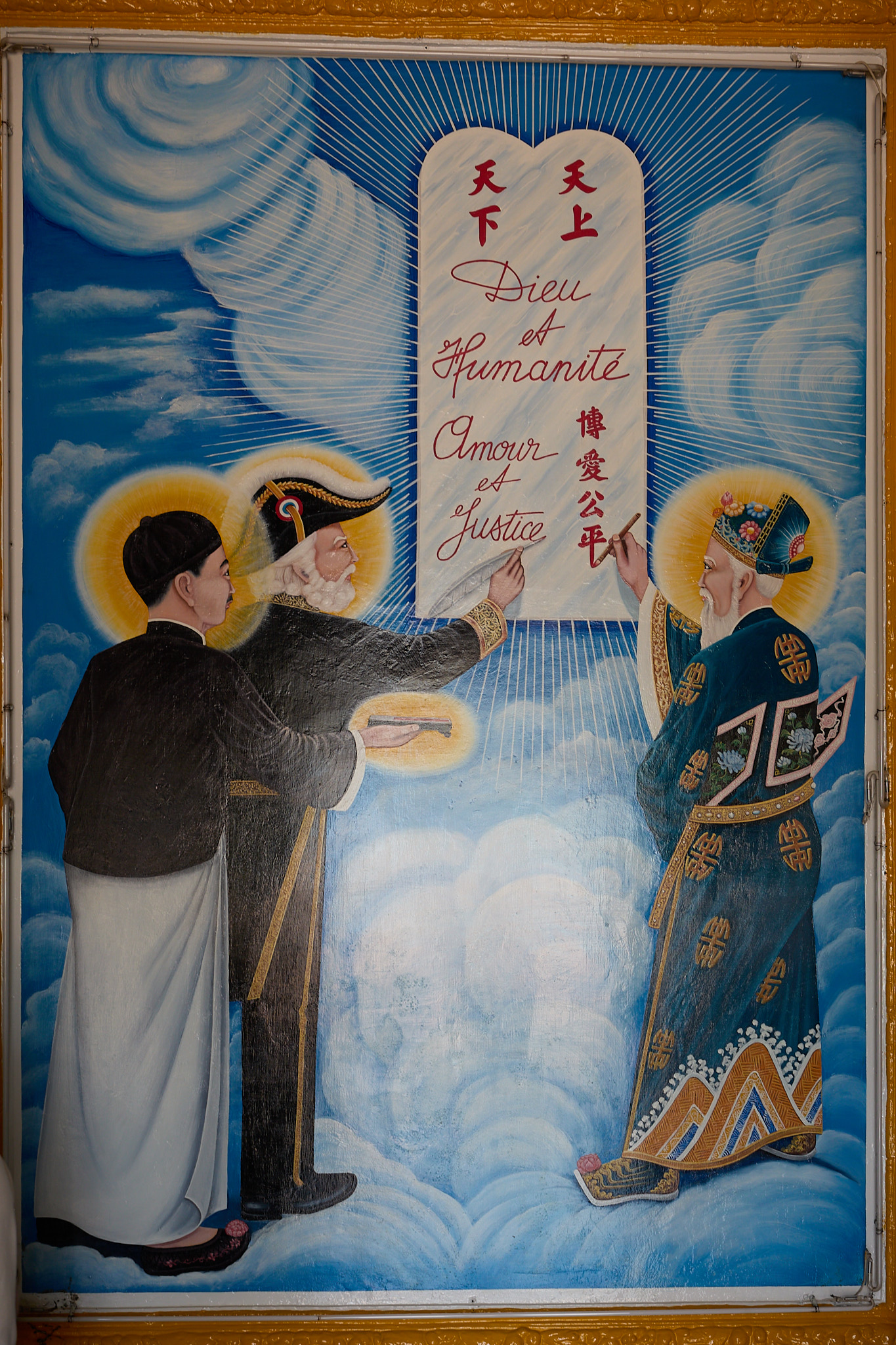
The man with the quill is Victor Hugo. The man with the inkstone is the Chinese revolutionary Sun Yat-sen. The man with the brush is Nguyễn Bỉnh Khiêm, a sixteenth-century Vietnamese poet remembered for his prophecies.
The painting hangs by the main entrance of the Holy See of Cao Đài, in Tây Ninh, north-west of Ho Chi Minh City. The three men, the faith says, are signing a covenant between God and humanity. It is the third. So there were two before it.
The third time
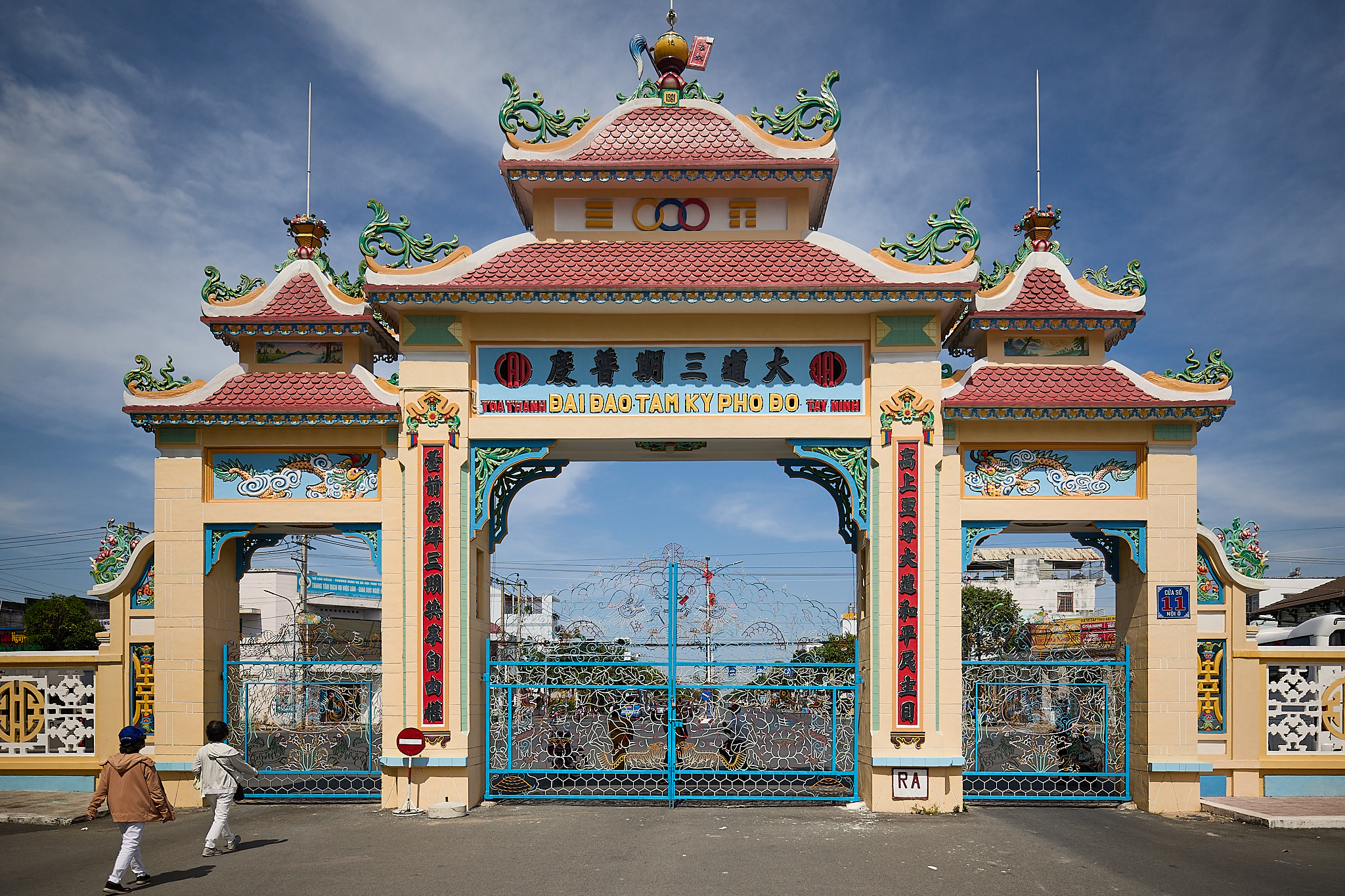
Cao Đài, or Caodaism, was founded in southern Vietnam in 1926. Its full name, written over the gates here, is Đại Đạo Tam Kỳ Phổ Độ: roughly, the Great Way of the Third Universal Salvation.
In its account, God has spoken to humanity before: in a first age through Moses among others, and in a second through the Buddha, Laozi, Confucius, Jesus and Muhammad. But those messages depended on human messengers, and humans are frail. This third time, God speaks directly.
The religions of the world, then, are not rivals here. They share a single source, which they have called by different names, and Caodaists are taught to love the followers of every one of them as brothers and sisters.
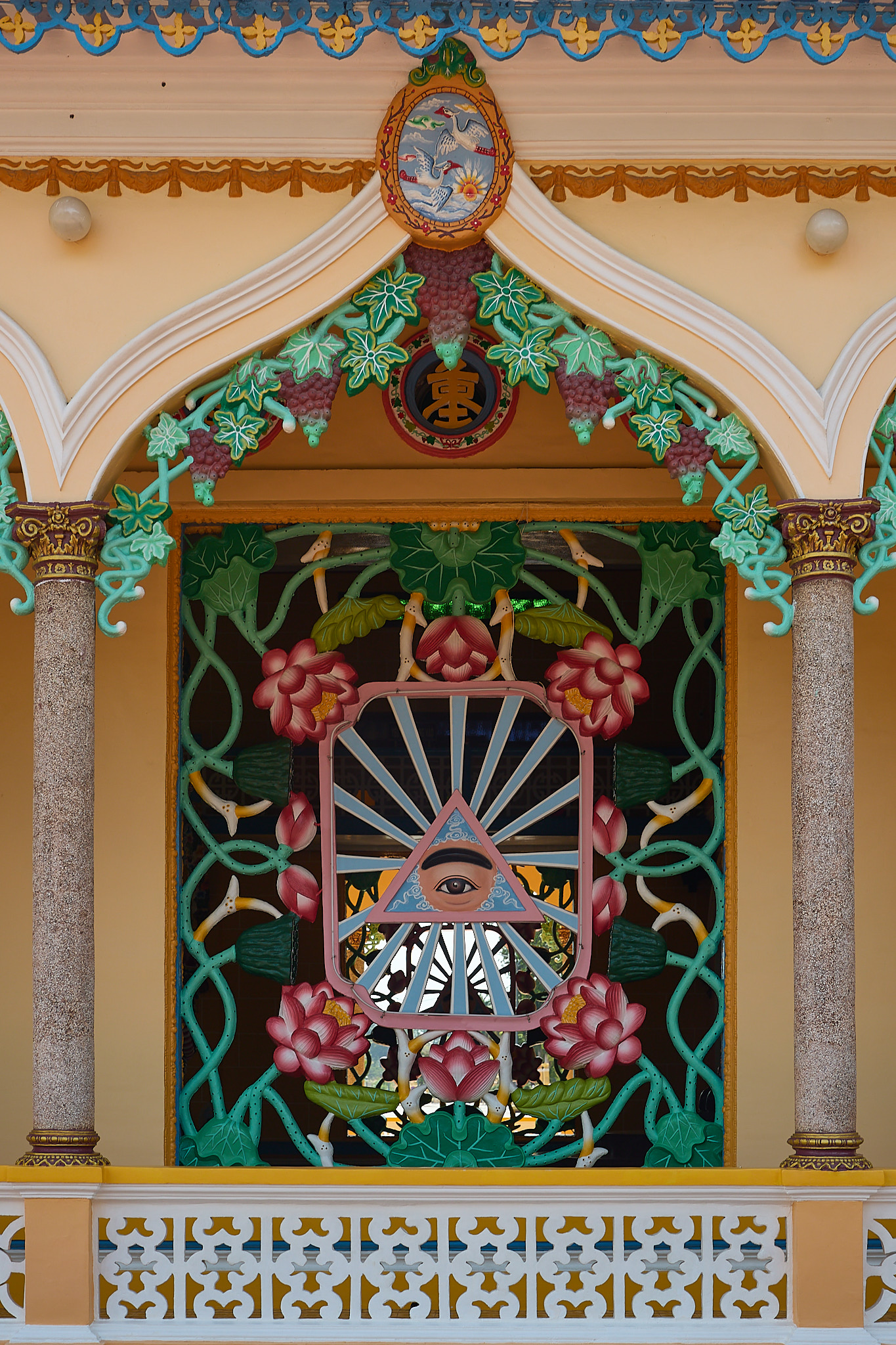
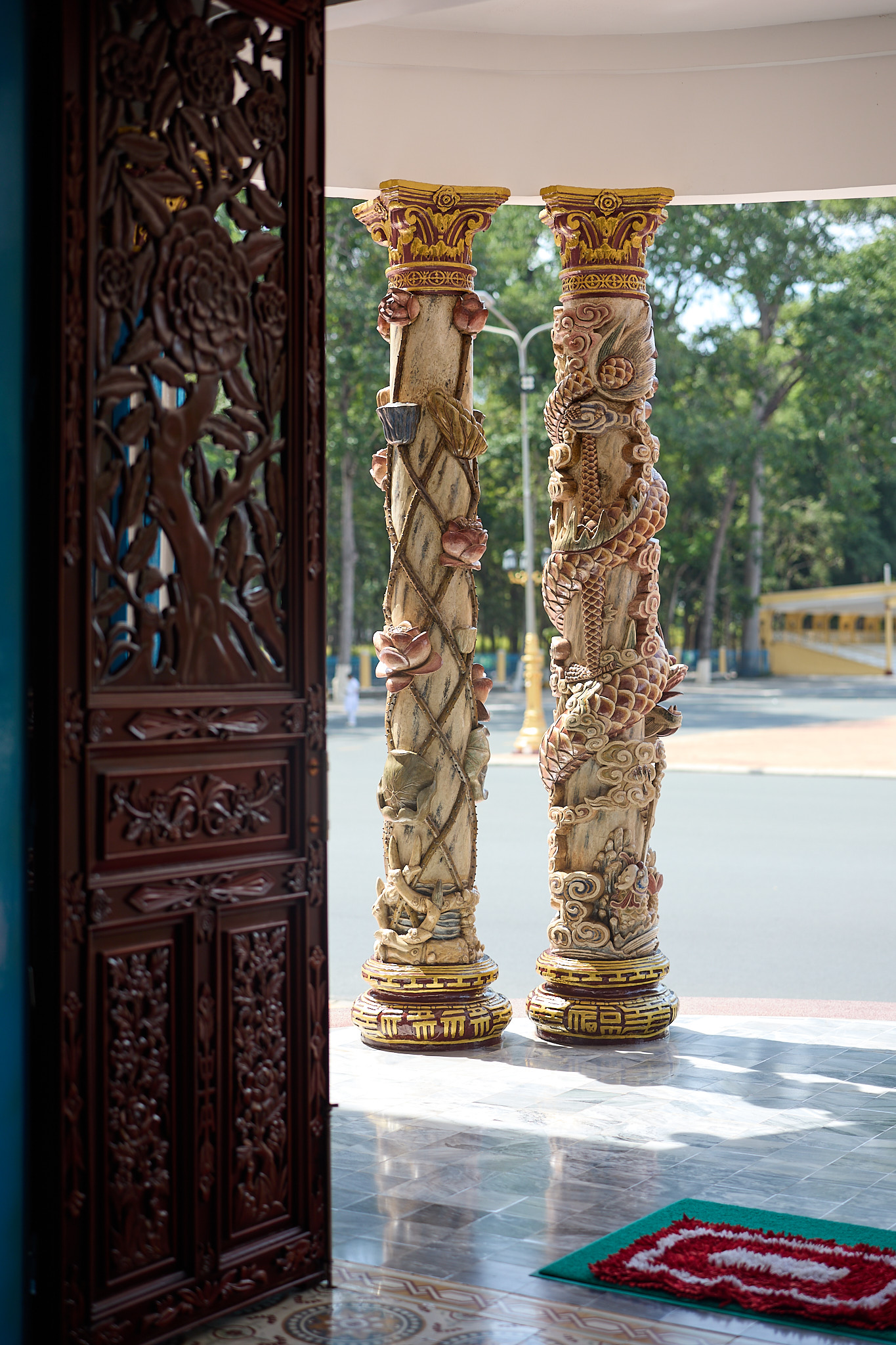
Twelve gates lead into the grounds, decorated with lotuses and the four sacred creatures of Vietnamese tradition: the dragon, the qilin, the turtle and the phoenix. Under the top roof of one of them, three rings are linked together, in yellow, blue and red: the faith’s colours for Buddhism, Taoism and Confucianism.
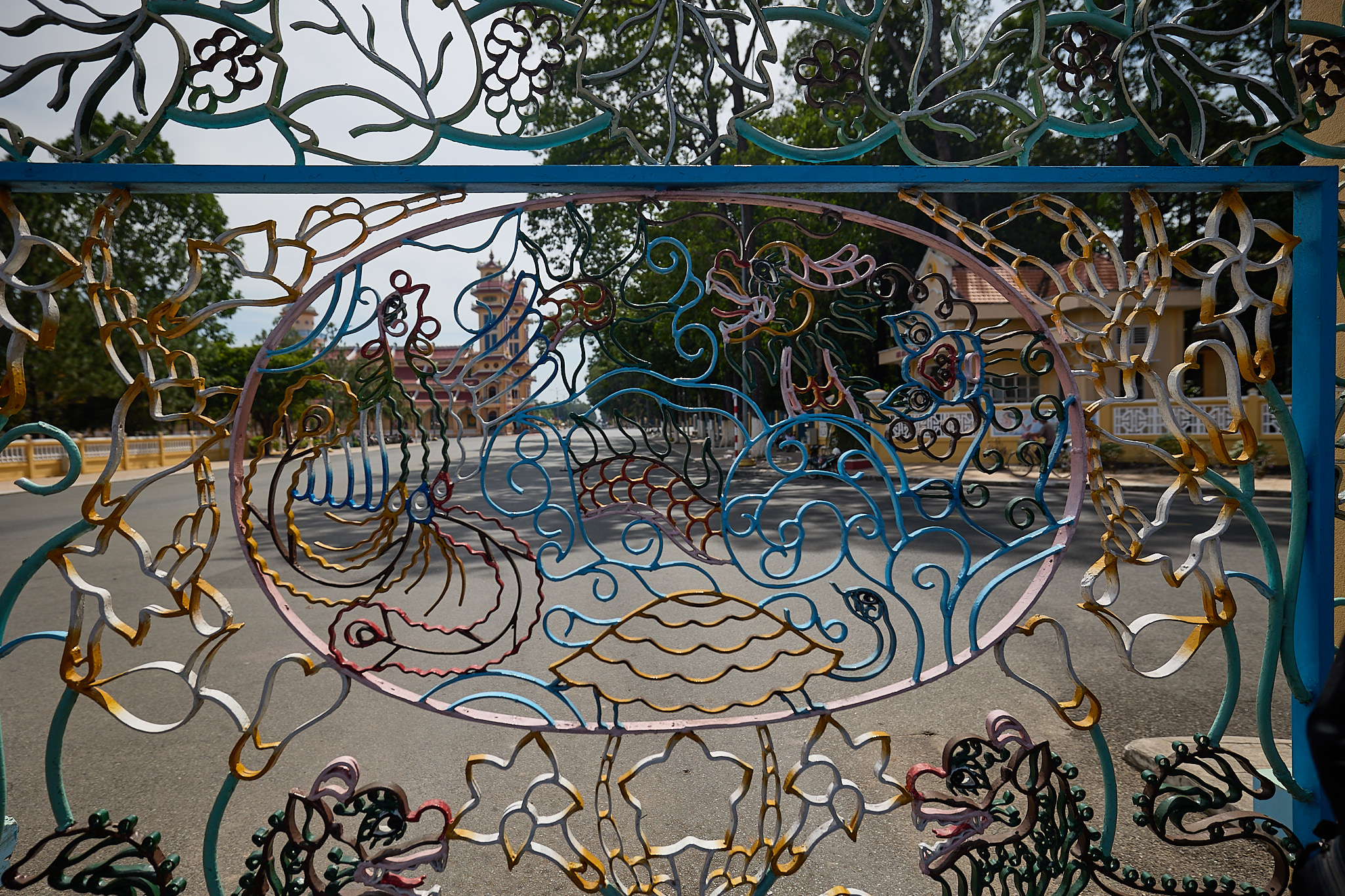
Noon
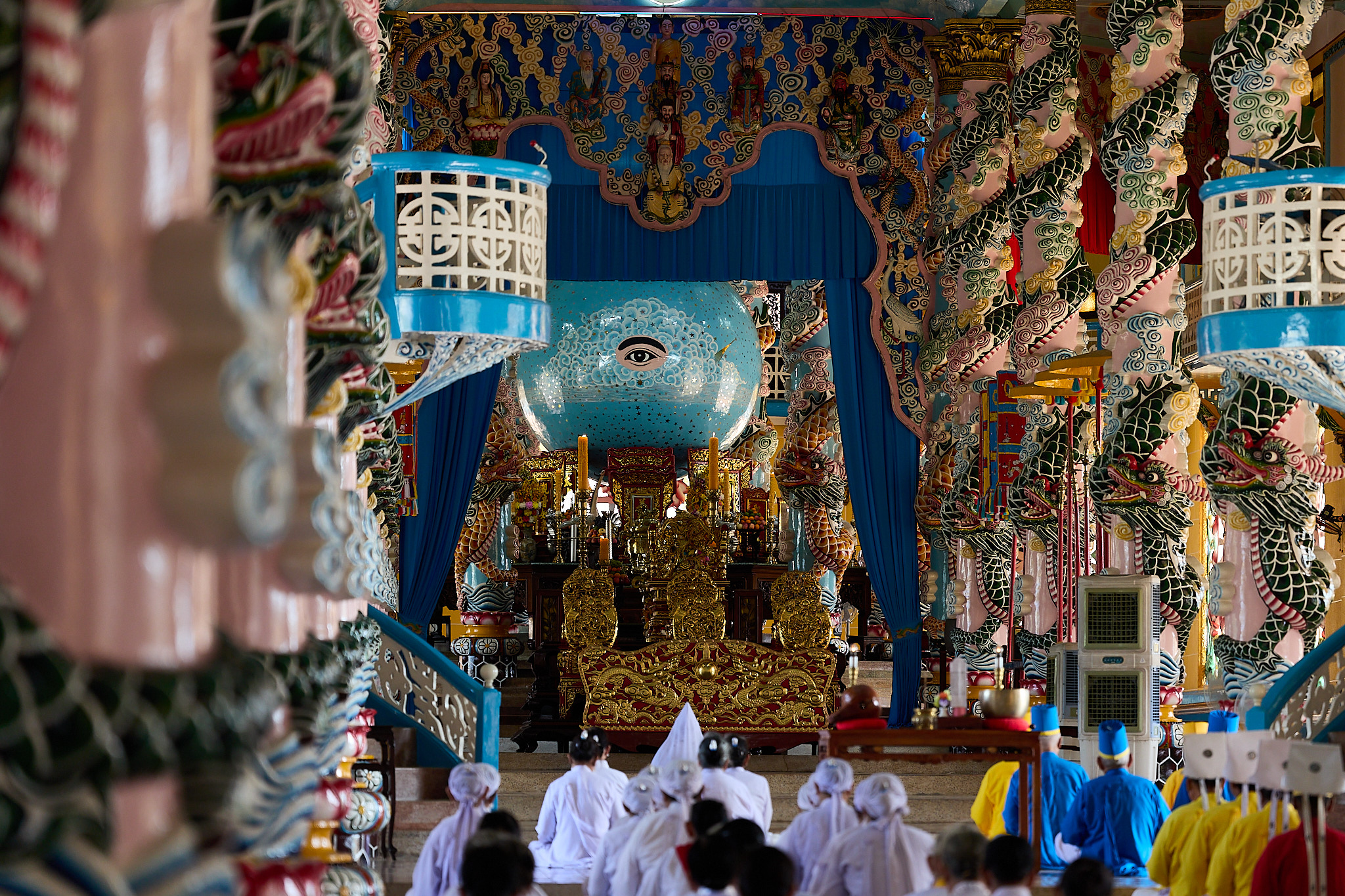
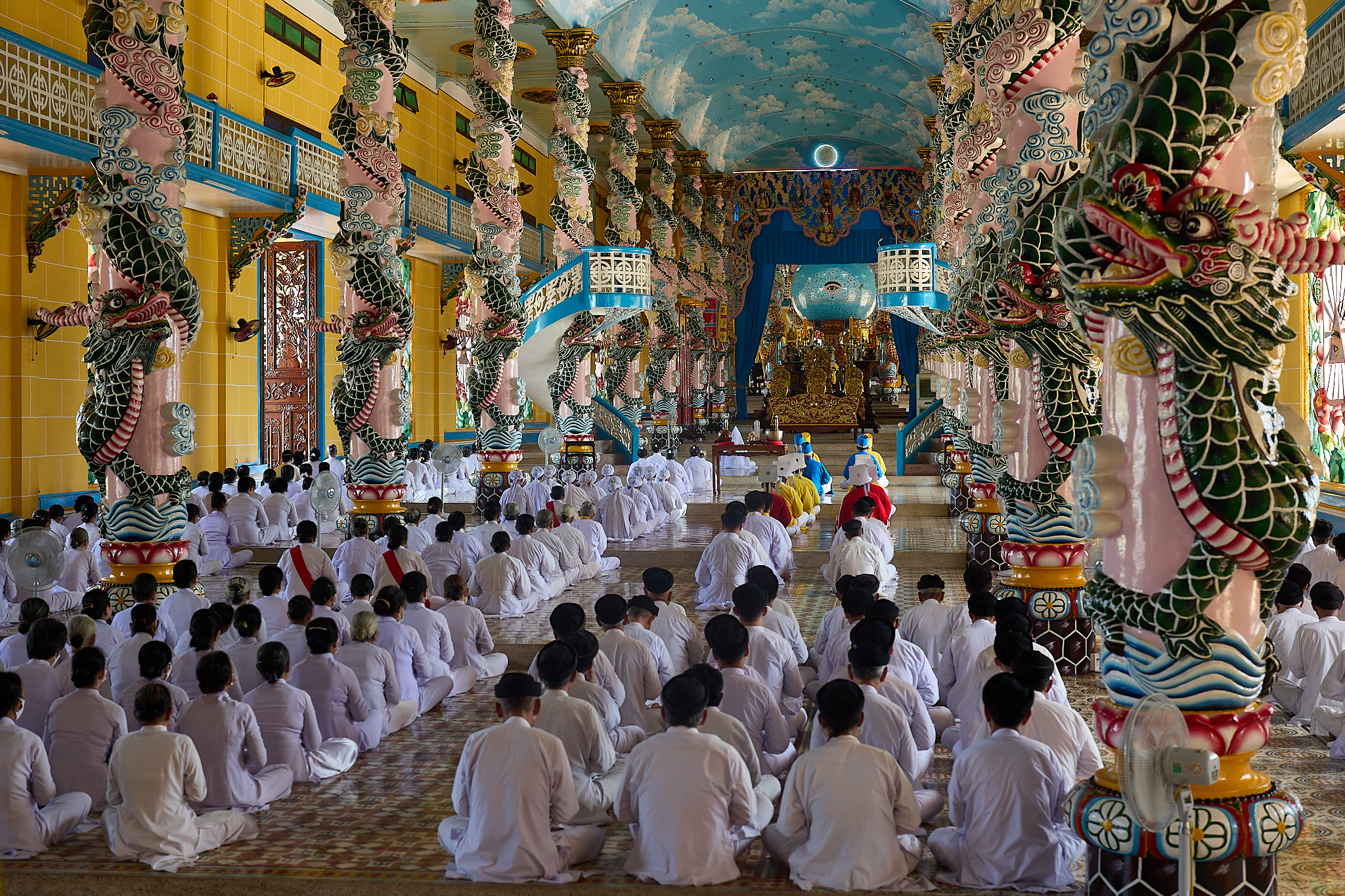
The faithful pray four times a day: at midnight, 6 a.m., noon and 6 p.m. When I went in, the noon prayers were under way, and I watched from the back of the hall.
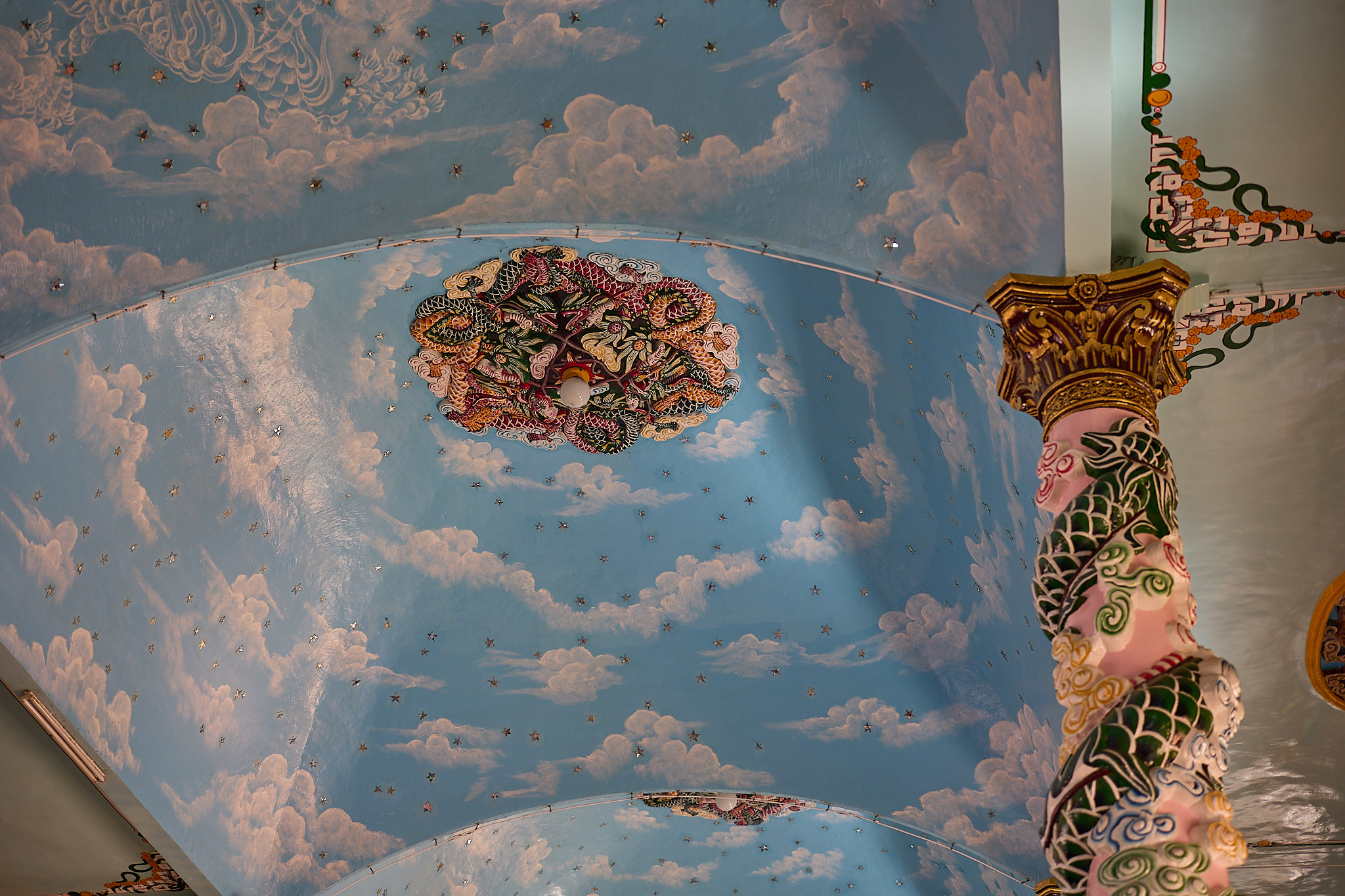
Rows of worshippers in white sat on the floor between pillars, each with a dragon wound round it. At the front, a few wore the colours from the gate: yellow, blue and red. Beyond them, the floor rises towards the altar in nine levels, one for each rank of the hierarchy. Overhead, the ceiling is a blue sky, its clouds and stars standing for the heavens.
There was chanting, and over it something that sounded like a flute. For as long as I watched, the hall seemed to sit slightly outside reality.
The eye
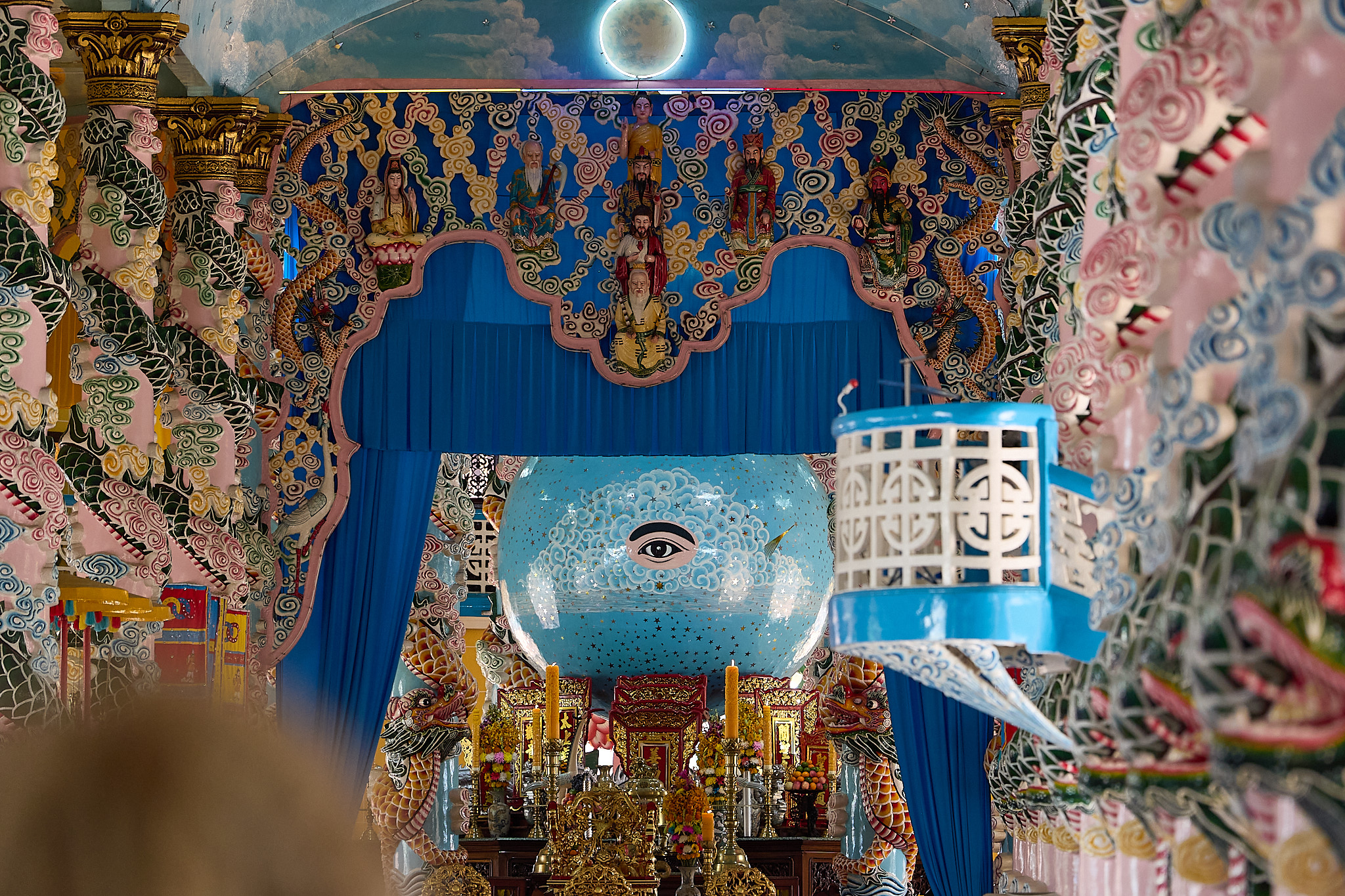
At the far end of the hall, above the altar, is the globe. The eye painted on it is the Thiên Nhãn, the Divine Eye, the faith’s symbol of God. It is, to be precise, the left eye. The story goes that the faith’s first disciple, Ngô Văn Chiêu, saw it in the sky over the island of Phú Quốc.
Around it are 3,072 stars, for seventy-two earths and three thousand worlds. I did not count them. Inside the globe, a lamp is kept burning day and night.
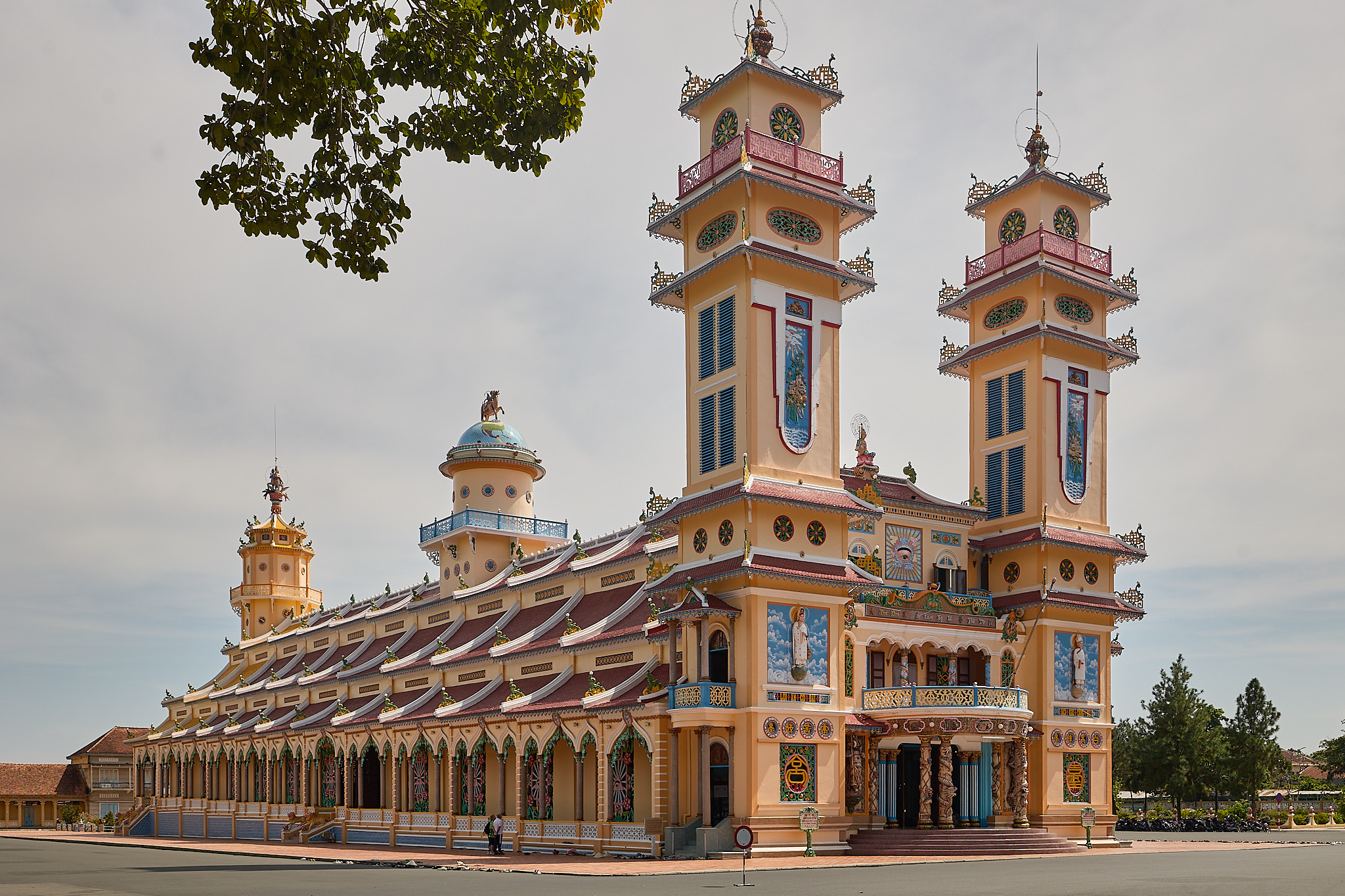
Outside, the eye is everywhere. It looks out of the side windows, one after another, from a triangle of rays. It looks out from the front of the building, high above the main door. And just inside that door, under it, Victor Hugo is still writing.
Dieu et Humanité
The painting began as an empty frame, built before it had been decided what should go in it. That was settled later, in talks with the painter, Lê Minh Tòng.
The three men in it did not found Caodaism. In the faith, they are spiritual guides, and Hugo’s part is a large one: he is regarded as the spiritual head of the faith’s overseas mission, and poems, advice and prayers are attributed to him.
Why Hugo? In colonial Indochina, he was by far the most widely read writer, known as a defender of the oppressed and a critic of surveillance and imprisonment. His young readers in Saigon also knew that he had taken spirits seriously.
In exile on Jersey in the 1850s, Hugo’s household spent two years at a “talking table”, with his son Charles as the medium. When a small group in Saigon began holding séances of their own in the mid-1920s, they used the same method. The group went on to found Caodaism, and the writer they had read and admired came to be venerated as one of its saints.
Caodaism is now a century old, and the world has not run out of reasons for religions to quarrel. In Tây Ninh, four times a day, the faithful still pray to the one God they believe spoke through the Buddha, Laozi, Confucius and Jesus alike. By the front door, a Frenchman and a Vietnamese poet are writing the same message in two scripts, while a Chinese revolutionary holds the ink.
Dieu et Humanité, Amour et Justice. Somebody has to keep writing it down.
Visit this place
Location
Tây Ninh Holy See (Tòa Thánh Tây Ninh)
In walled grounds in Long Hoa, south-east of central Tây Ninh and a short drive from Bà Đen mountain
Phạm Hộ Pháp, Long Hoa, Tây Ninh, Vietnam
Practical Information
- Getting there
- About 100 km north-west of Ho Chi Minh City; allow roughly 2–3 hours by road each way. Bà Đen mountain is a short drive away.
- Services
- Daily at midnight, 6:00, noon and 18:00, with larger services on the 1st and 15th of each lunar month. Most visitors come for the noon service.
- Visitor note
- An active place of worship. Visitors do not use the main front door: men and women go in by separate side doors. Take off your shoes before going in and dress modestly. Some areas inside are marked no photography. On a 2025 visit, visitors watched the noon service from the back of the hall.
- Admission
- No admission fee.
Information last checked: November 7, 2026 (Service times from Tây Ninh province’s tourism page on the Holy See; visitor rules from recent visitor guides, not confirmed with the Holy See itself. No admission fee on a 2025 visit.)
Conversation
Comments
Review pending commentsComments are reviewed before appearing. The internet already contains enough unattended surprises.
Loading comments…
Leave a comment