Belgrade’s Non-Aligned Obelisk: Raised in a Day, Never Taken Away
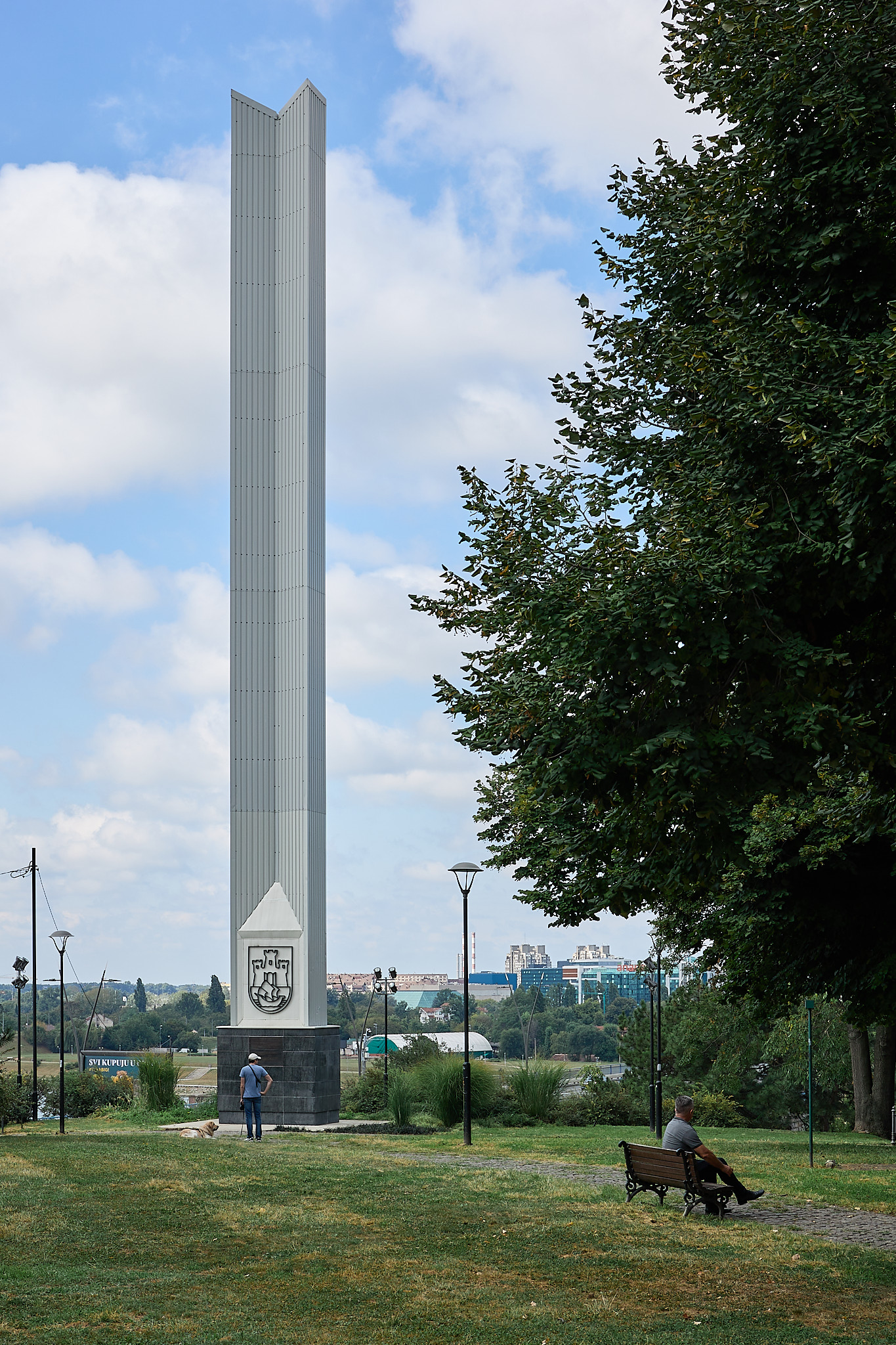
As obelisks go, the one above Branko’s Bridge in Belgrade is short on stone. There is some on the base, as a facing over concrete. The shaft is a lattice frame in a white skin, and the frame, according to the people who built it, was put together from parts made for electricity pylons.
It went up in 1961, when the leaders of twenty-five countries that had sided with neither Washington nor Moscow met in Belgrade for the first conference of the non-aligned countries. The city was dressed for the occasion with temporary decorations, and the obelisk was one of them. They were to be dismantled as soon as the conference was over.
The conference ended on 6 September 1961.
Ten days
Sixty years later, one of the engineers on the job, Branimir Grujić, wrote down how it had been done.
Shortly before the conference, he recalled, the organising committee formed two teams: four architects and four structural engineers. Each got a telephone call summoning them to the City Assembly, where a job of exceptional importance would be explained. Working hours would be unlimited. They had about ten days.
The architects were to design two obelisks, a triumphal arch and a triangle for peace, independence and equality. One obelisk was for the old-town end of Branko’s Bridge, on the route between the conference’s two venues: the National Assembly, where the working sessions were held, and the newly opened federal government building across the Sava, which had the ceremonies.
The engineers had to find structures that could go up fast and come down again. For all the other decorations, the answer was scaffolding: steel tubes and couplers, which every large building firm already owned. At the bridge, the obelisk’s dimensions ruled scaffolding out.
By chance, Grujić wrote, every engineer in the group had worked on the design of a high-voltage pylon, and they knew of a plant that had both the ready-made parts and the equipment for raising a pylon assembled on the ground. One leg of that pylon, triangular in cross-section, suited an obelisk perfectly. Because of the height, about twenty-five metres, the architects agreed to two such triangles, welded together where their corners met and wrapped in sheet metal.
The obelisk was assembled lying down. Then a crew from the enterprise that had designed the pylon stood it upright in the course of a single day.
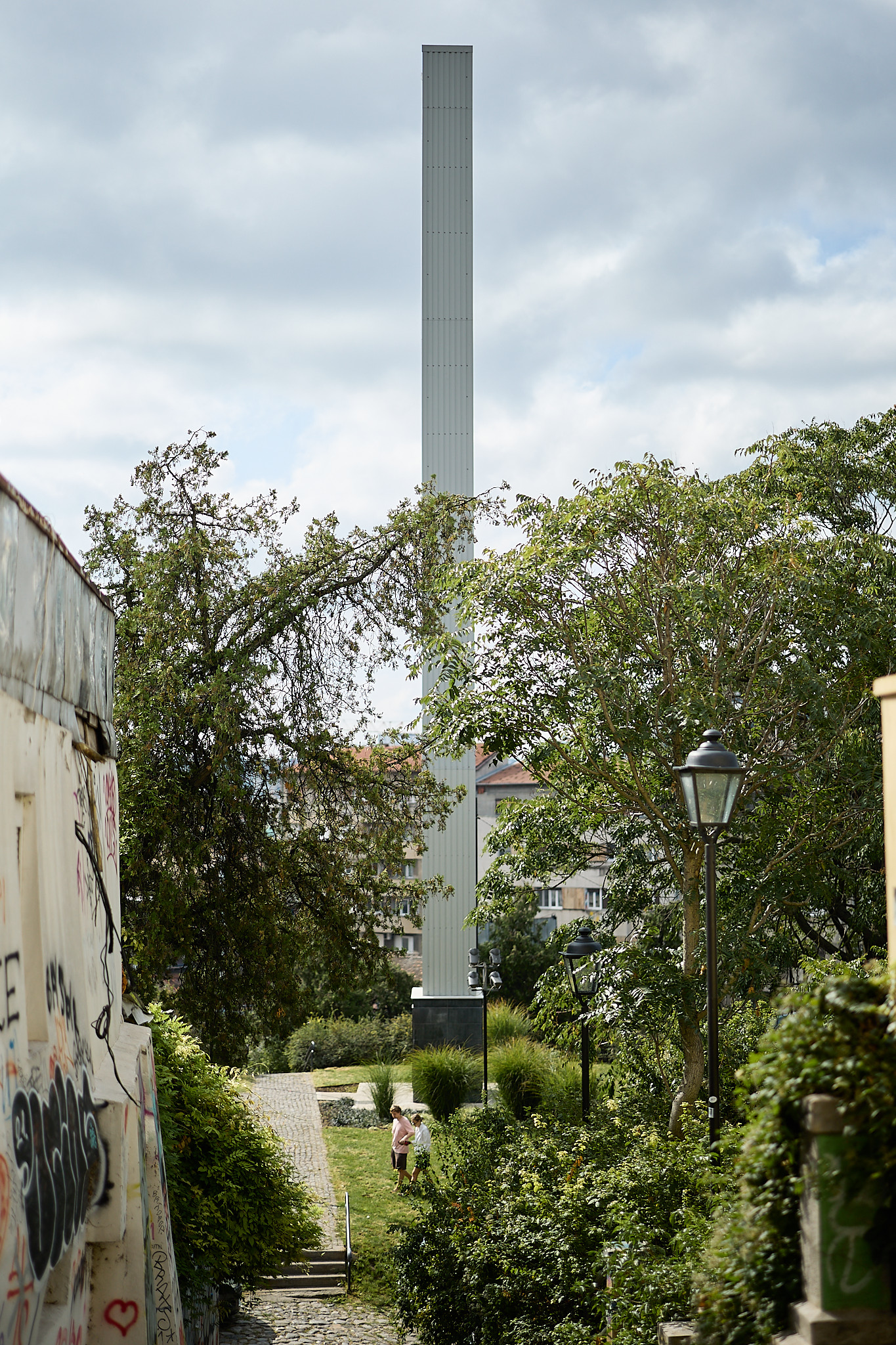
From the lawn, the shaft looks broad, and its top ends in a V-shaped notch. From the cobbled lane that drops into the park, it looks like a thin slab with a flat top.
The other obelisk, on what was then Marx and Engels Square, was taller, covered in cloth and edged with neon. It was finished in a rush, in the rain, and at one point it caught fire, probably from a cigarette end. An investigation followed.
When the conference closed, the decorations came down at once, the neon obelisk among them. The one made of pylon parts stayed. Grujić could only guess why: its position and its looks, probably, and the wish of an “important person” of the day. The quotation marks are his. He names no one.
Credits
Grujić’s account comes with a cast list. He names three of the architects, D. Milenković, S. Vuković and S. Ličina, and says he cannot recall the fourth. He names three of the engineers, himself among them. The name of the fourth, he writes, has faded from his memory with time.
So who designed the obelisk? In March 2014, a Belgrade newspaper reporting on the graffiti scrawled over it credited the painter and architect Siniša Vuković, as many articles had before. Then the newsroom heard from two people. One was the widow of the architect Dušan Milenković, herself an architect, who said the obelisk was her late husband’s work. He had wanted it made of copper, she said, or at least covered in copper, but that had not been possible. The obelisk got sheet metal. The other was an architect who said that the idea, and the choice of site, had been his colleague Svetislav Ličina’s.
Ličina was there to be asked. By his account, the team had four architects: Milenković, who led it, Ličina himself, and two others, one of whom later became a well-known set designer. Vuković was not among them.
For five days, Ličina said, the four worked in the City Assembly almost without a break, and everyone contributed ideas. His own was an obelisk above the Sava. Since they were in such a hurry, he decided to take two triangular pylons and join them.
Grujić’s list and Ličina’s have two names in common. The pylons have two origins as well: Ličina’s decision, or engineers who happened to know where the parts were.
The records are no help. In 2014, neither the city archive nor the city’s institute for the protection of monuments had any documentation on the obelisk. The likeliest reason, the newspaper suggested, was that the obelisk had only ever been a stand-in, meant to be replaced one day by a permanent monument.
An online catalogue of Belgrade’s non-aligned heritage gives the obelisk an entry like any other: name, park, dates.
Under “author”, it says: it’s complicated.
Two conferences
What the obelisk carries, where a signature might go, belongs to the city. At the foot of the shaft, drawn in strips of metal, is Belgrade’s coat of arms: a fortress with an open gate and, beneath it, a ship under sail. In Grujić’s memory, it was the only thing on the obelisk in 1961.
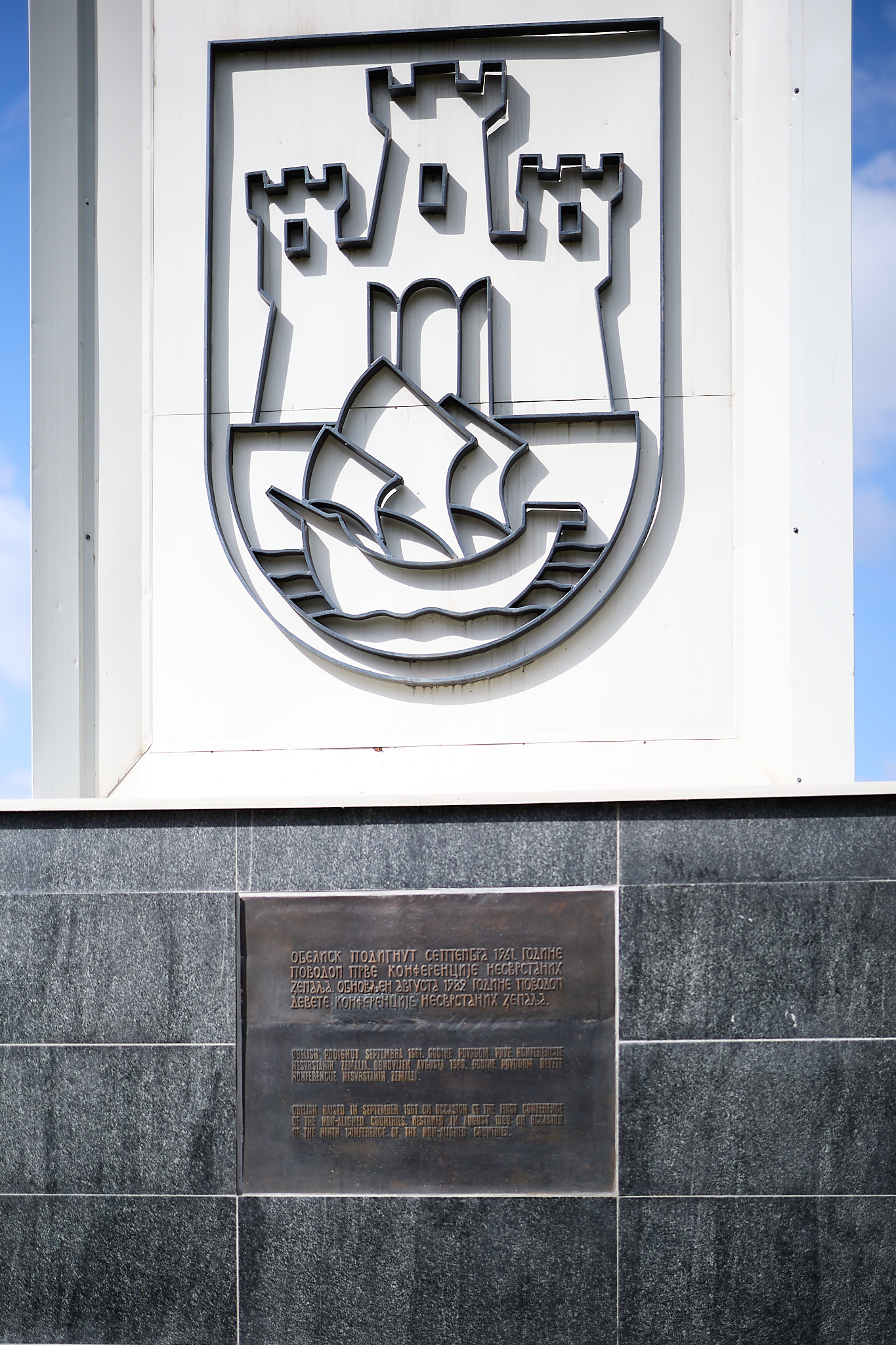
Below, on the stone of the base, a bronze plaque says one thing three times: in Serbian in Cyrillic letters, in Serbian in Latin letters, and in English. The Cyrillic is cast in an ornate, old-fashioned hand; the other two make do with plain capitals. The obelisk, it says, was raised in September 1961 for the first conference of the non-aligned countries, and restored in August 1989 for the ninth.
The ninth made Belgrade the first city to host the summit twice. The plaque was added then.
Twenty-eight years after it was due to come down, the temporary obelisk had a plaque in bronze.
The country that hosted both conferences broke up within a few years, and Serbia now sits in the movement as an observer.
In September 2026, the sixty-fifth anniversary of the first conference was marked with a commemorative meeting at the Palace of Serbia: the former federal government building, at the far end of the route on which the obelisk still stands.
Upkeep
Over the decades the skin has changed, in colour and in material. Underneath, Ličina said in 2014, the two pylons were still there.
In December 2005, for a month of campaigning on HIV awareness, volunteers dressed the whole obelisk in a giant cloth condom. They did not have the approval of the monuments institute. City inspectors ordered the cloth removed, and climbers were brought in to do it. It stayed up for a few days: by the standards of this spot, a very short run for something temporary.
The base, meanwhile, collected spray paint. In 2014, city crews were cleaning it off every two or three months. For the sixtieth anniversary, in 2021, the damaged stone facing was replaced with new slabs, cut to the original dimensions and treated against graffiti. The plaque was cleaned and put back on the front.
In December 2022, the new stone was reported sprayed with black paint, and the plaque crossed out. Both were cleaned again.

The newspaper that went looking for the designer in 2014 put its findings in the headline: “On the obelisk of the Non-Aligned Movement, only the graffiti artists have signed.”
On a September morning in 2023, I found the plaque and the stone around it free of paint.
For the moment, the front of the obelisk was signed by no one at all.
Visit this place
Location
Obelisk of the Non-Aligned Countries / Обелиск несврстаних земаља
In a small park at the Old Town end of Branko’s Bridge, above the Sava
Fruškogorska, 11000 Belgrade, Serbia
Practical Information
- Access
- An outdoor monument in a small public park, seen from the paths around it.
- Visitor note
- Not to be confused with Friendship Park (Park prijateljstva), across the Sava in New Belgrade. It was also laid out for the 1961 conference, and has an obelisk of its own, the Eternal Flame of 2000.
Information last checked: November 24, 2026 (Location, the park’s name and outdoor access checked. No opening hours are published for the park.)
Conversation
Comments
Review pending commentsComments are reviewed before appearing. The internet already contains enough unattended surprises.
Loading comments…
Leave a comment