Prague’s Kafka Statues: Two Ways to Split a Writer
In Prague, Franz Kafka has been split in public twice: once into two pieces, and once into forty-two.
Both are statues, on opposite sides of the Old Town.
Nobody in the suit
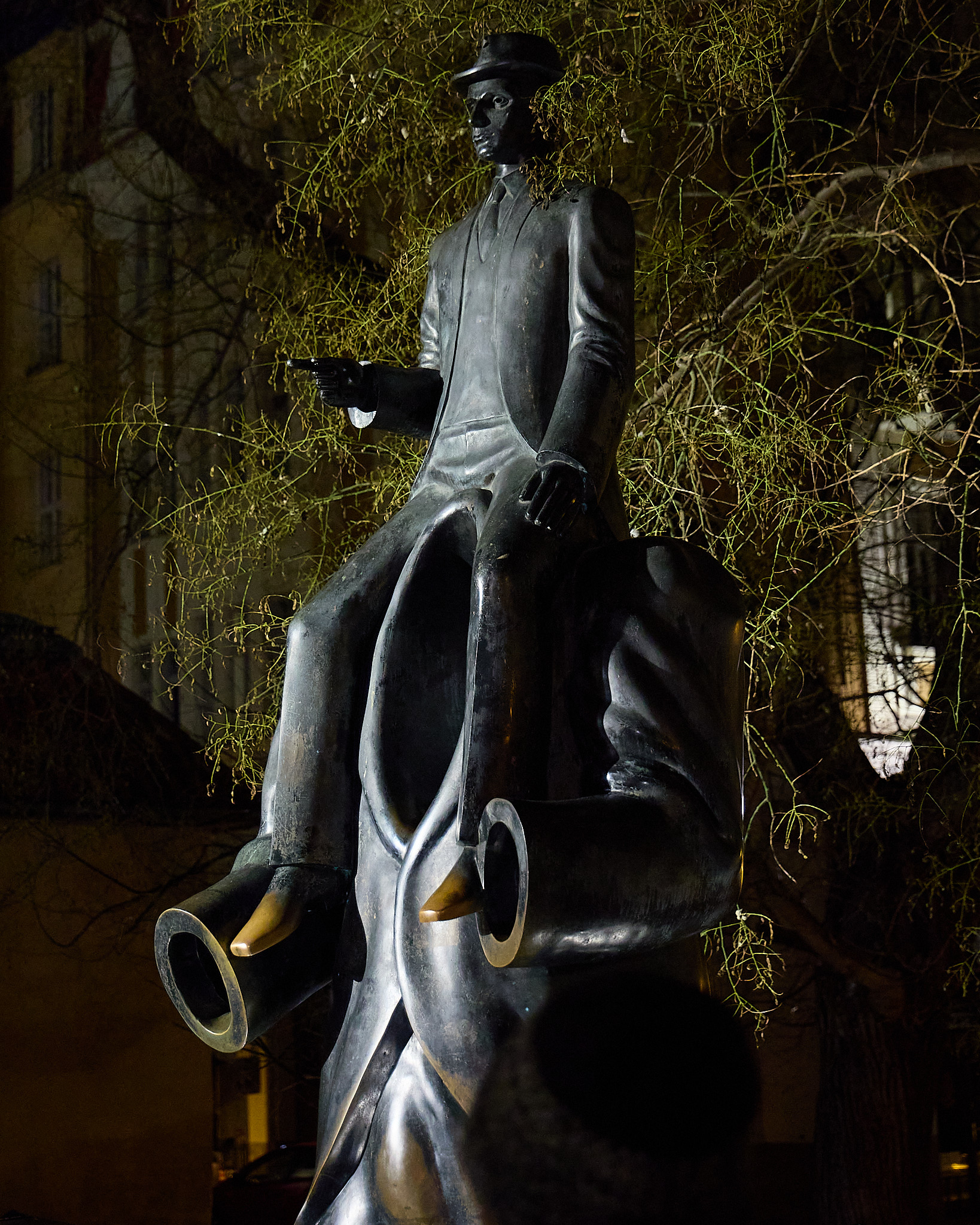
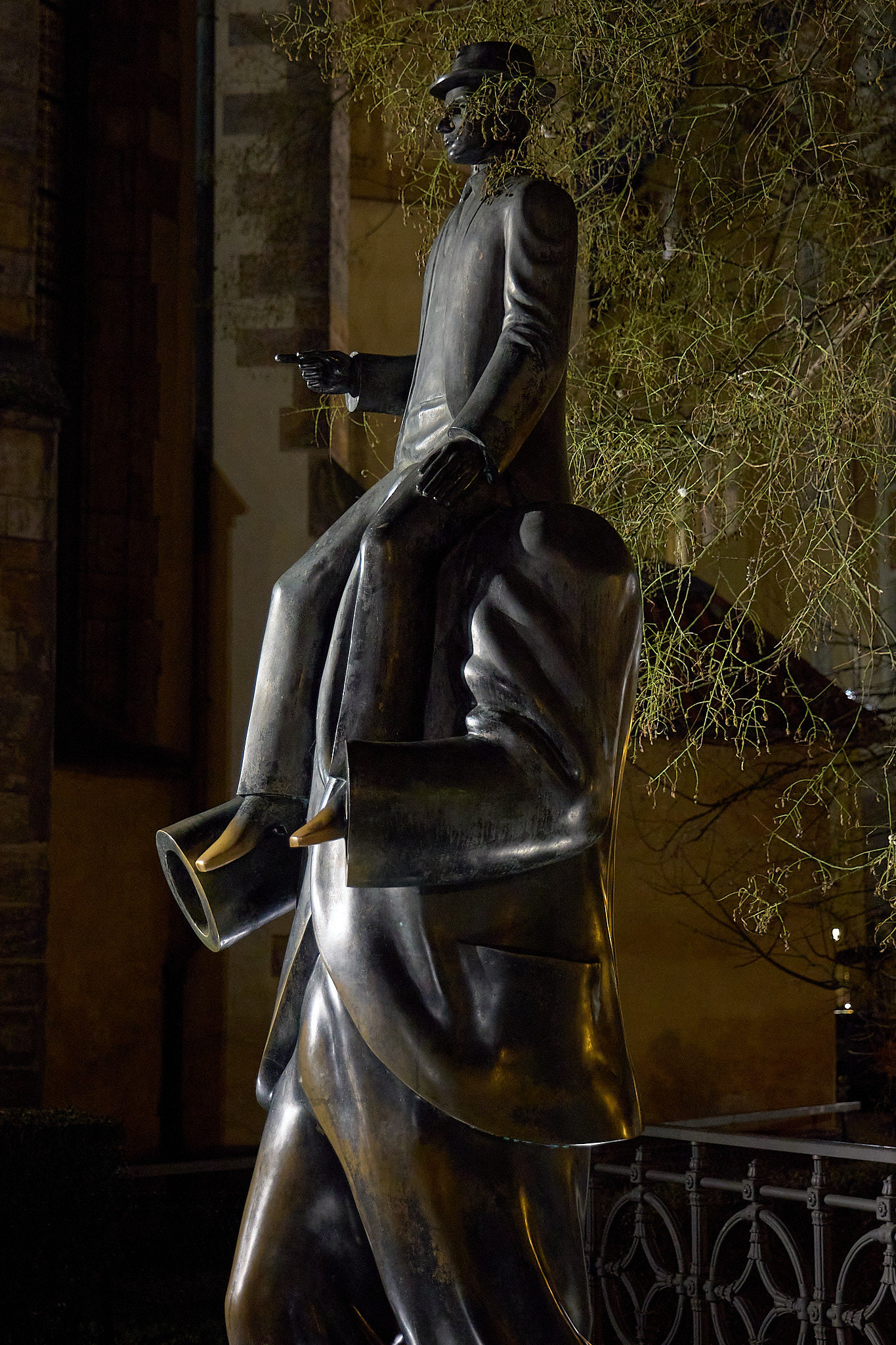
I went looking for the first one on a December evening, and found that plenty of other people had had the same idea. It has stood since 2003 in a small square between the Spanish Synagogue and the Church of the Holy Spirit. On top, a slight man in a hat and tie rides on a giant’s shoulders, pointing ahead. Underneath, the giant turns out to be only a suit: a jacket and trousers, walking, with no head, no hands and nobody inside.
Kafka died in 1924. A plaque with his bust went up at his birthplace in the 1960s, but a monument took until 2003. For four of the decades in between, the country was run by a Communist government that mostly preferred to leave him out. Markéta Mališová of the Franz Kafka Society has recalled a local man asking her, in the early 1990s, who this Kafka was, and whether he was American. All he ever saw of Kafka was on American tourists’ T-shirts.
In the speech he wrote for the unveiling, the sculptor, Jaroslav Róna, pointed out that “any society other than a democratic one would never agree to its creation”.
Róna had won the Franz Kafka Society’s competition for the monument. He took the pose from one of Kafka’s early stories, “Description of a Struggle”, in which the narrator jumps onto an acquaintance’s shoulders and drives him off at a trot. Róna has linked the two bodies to a split that shows in Kafka’s own writing. The statue is also said to nod to the diaries, where Kafka complains of having too little time to write and wishes he could split into two people. He had a day job in insurance. It is tempting to conclude that the suit is the one who went to the office.
The site was chosen as carefully as the pose. The Kafkas once lived on this street, and the line between the Old Town and Josefov, the former Jewish quarter, runs exactly under the statue.
The face was another matter. Róna has said he suffered terribly over Kafka’s profile. Every surviving photograph showed Kafka from the front, or nearly, and none of them settled the nose. A few drawings persuaded him that it was hooked, though nothing could confirm it. He admits to having turned over the idea of exhuming the skull, to get the face right. “But of course I would never dare to do that,” he said.
The skull stayed where it was. The nose is his best guess.
A face, eventually
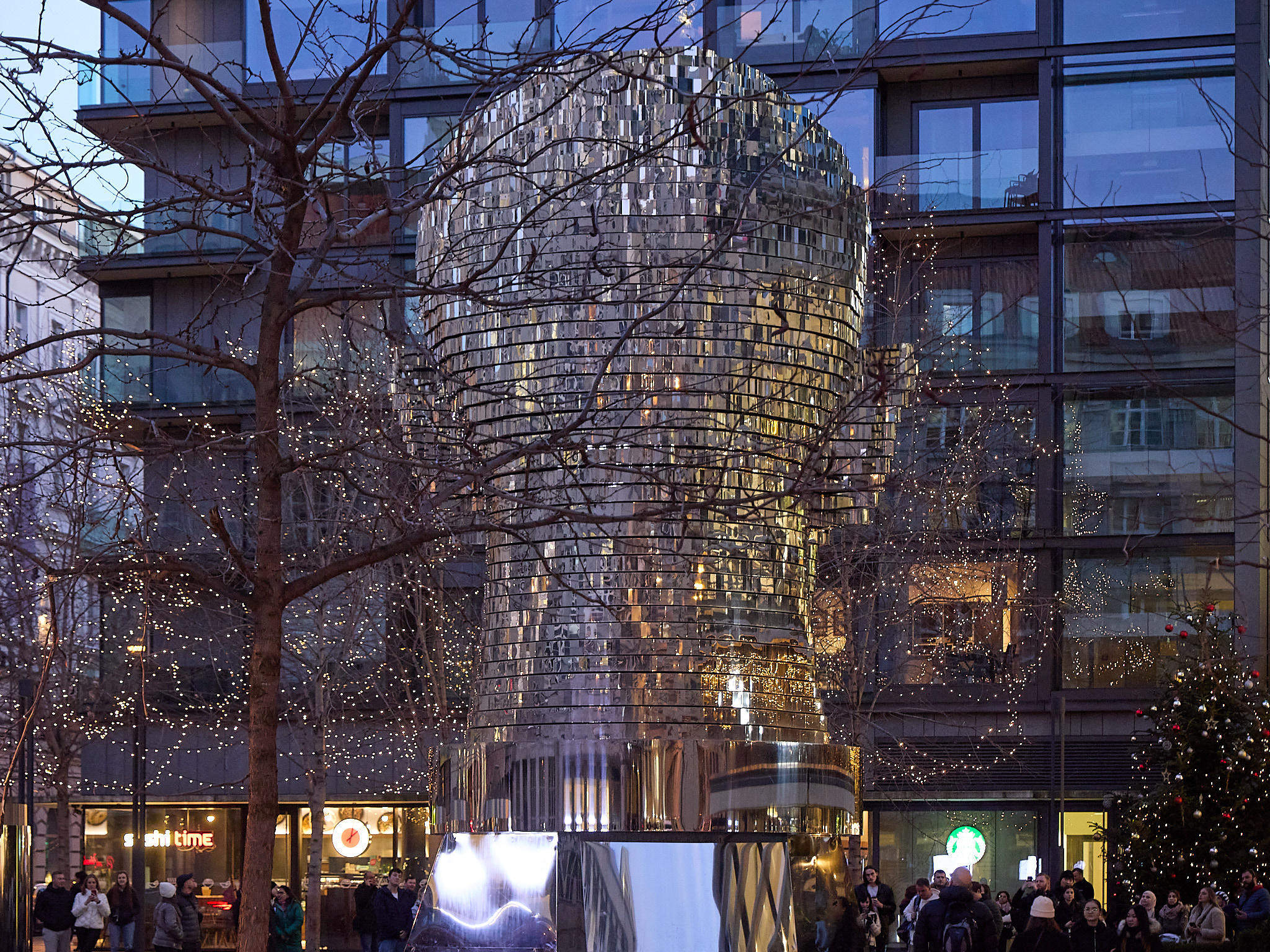
A few days later, I went to see the second Kafka. It is the reverse of the giant: a head and nothing else, about eleven metres of mirrored steel, plinth included, put up in 2014 outside the Quadrio shopping centre, next to a metro station. When I got there, it was not obviously anything. Its forty-two layers were turning, each on its own, and the whole thing looked like a tall stack of very shiny plates. A minute or so later, the layers had come round to face the same way, and a man was staring out over the crowd: brow, nose, lips, a pair of ears.
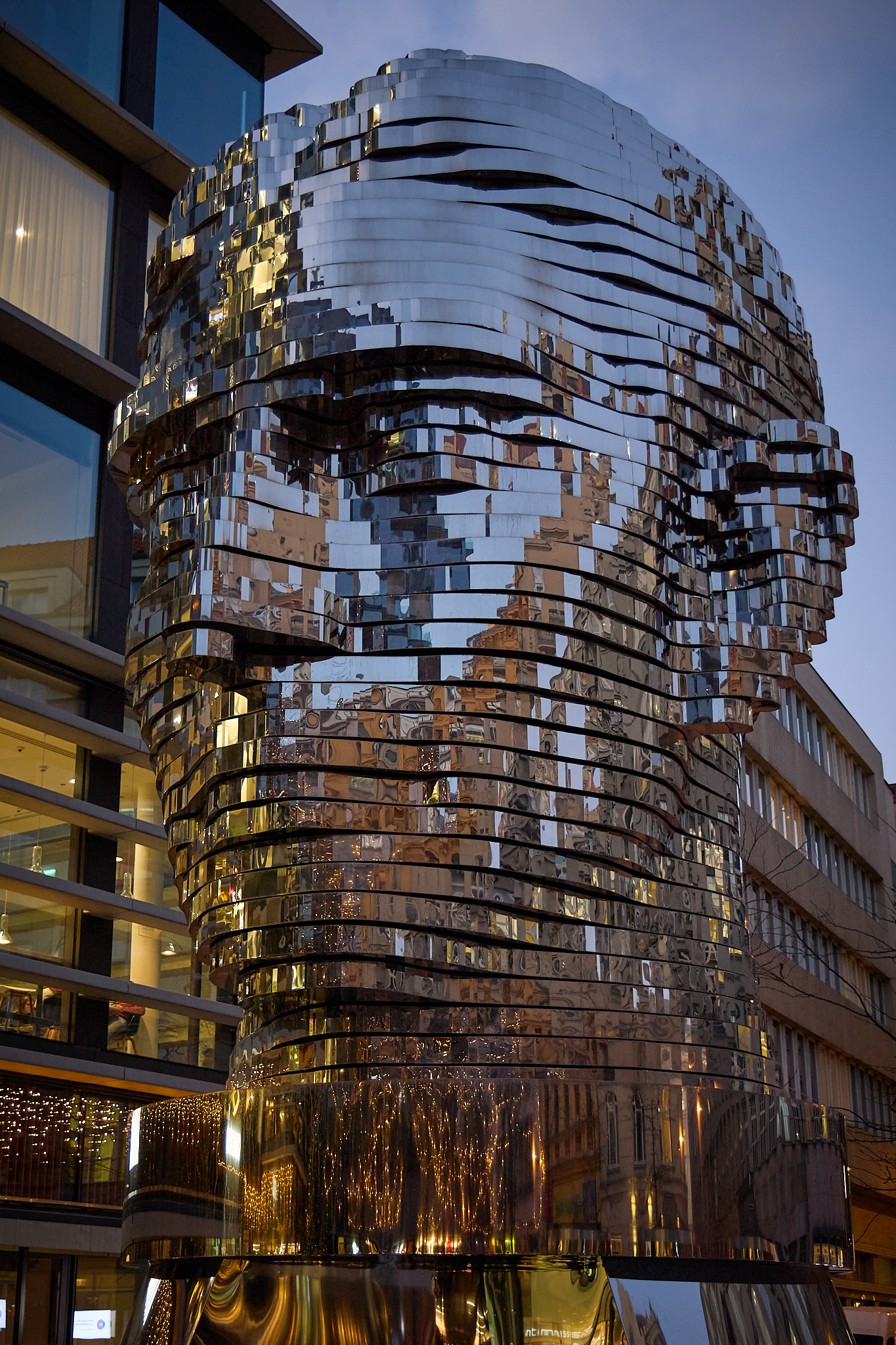
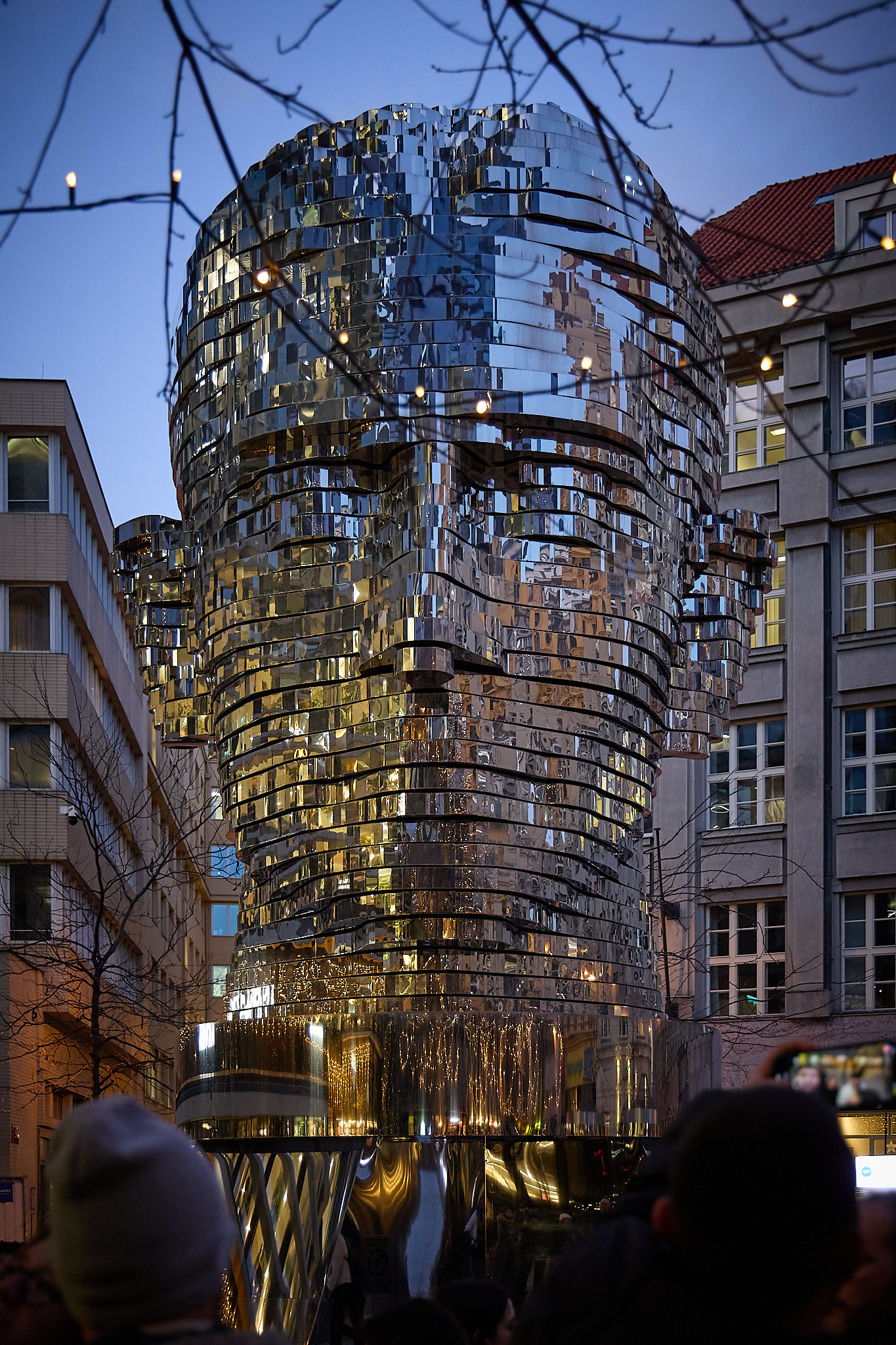
Its sculptor, David Černý, did not set out to make a head. His first idea for the site was a fountain with three figures, one for each language the city used to speak: a robot for Czech, a Golem for Yiddish and Kafka’s beetle for German. City water regulations ruled out a fountain, so Černý went back to something he had made before. Some years earlier, he had built a mirrored head of turning layers for an office park in Charlotte, North Carolina, where it was set in a pool and made to spit water. By Černý’s account, that first head was a self-portrait of his own state of mind. For Prague, he made it bigger and gave it Kafka’s face.
When the head was new, it turned all day. The parts wore, and the owner kept cutting its hours; by the time I stood in front of it, it was down to fifteen minutes in each hour. Černý says he had wanted a different mechanism, was overruled by the client, and warned that in ten years it would cost them a heap of money. Nine years on, a crane arrived and lifted the head apart from the top down, one layer at a time. It went back to work in February 2024, in the centenary year of Kafka’s death, with a new turning mechanism of the kind used in wind turbines. The fifteen minutes stayed. In between, the layers are now said to give the occasional discreet wriggle.
The head faces one of the city’s administrative buildings, an irony Černý has said he loved. Picture yourself in there, he suggests, sent by the clerks from one office to the next until you reach one that is closed. Then you walk out, and Kafka’s enormous head is looking back at you. English has a word for that kind of afternoon: Kafkaesque.
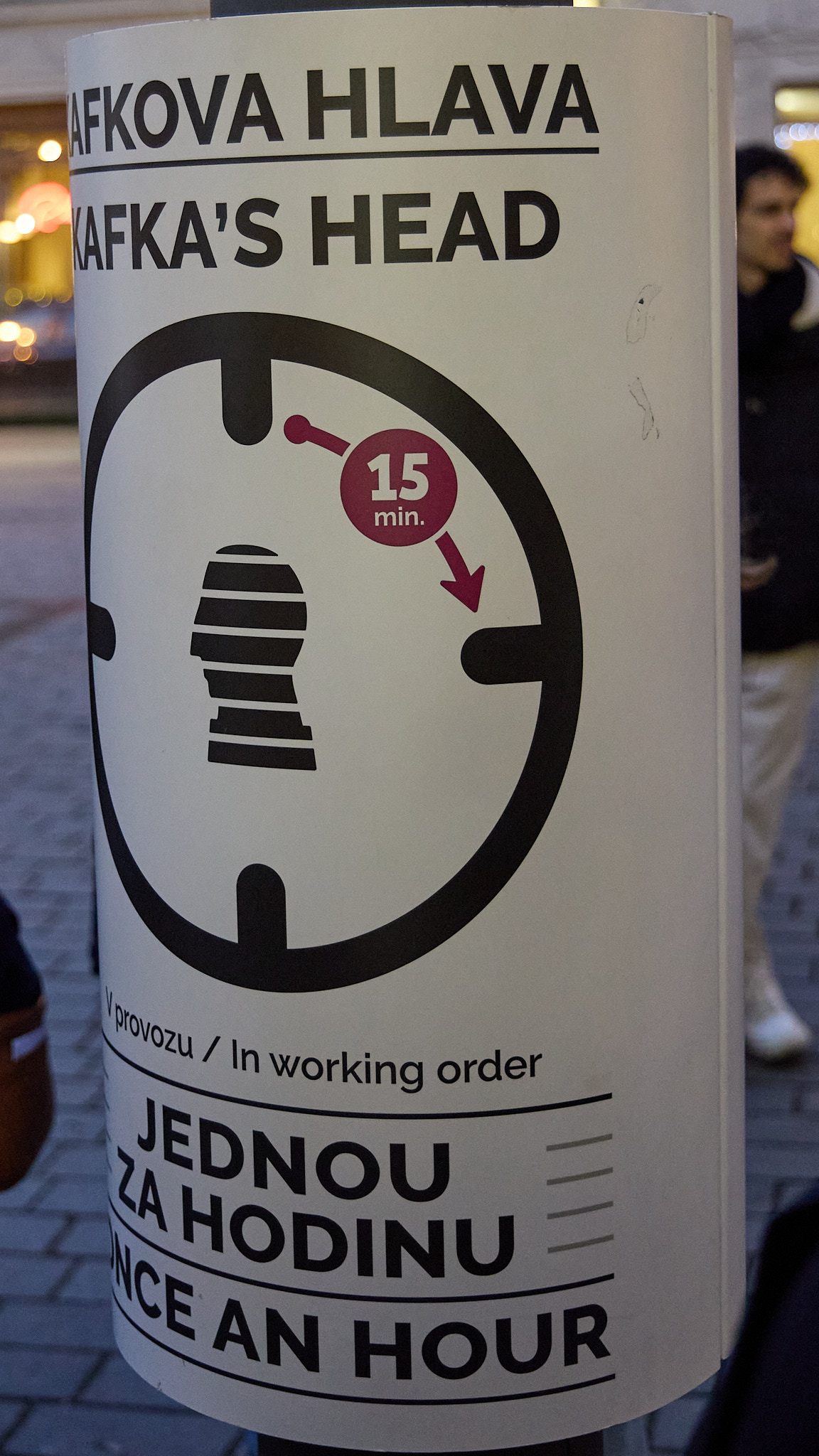
Near the head, when I was there, a sign on a post gave its particulars in Czech and English. Leave out the Czech, and it read:
Kafka’s Head. 15 min. In working order. Once an hour.
Visit this place
Location
Head of Franz Kafka (David Černý), Quadrio
Outside the Quadrio shopping centre, beside Národní třída metro station. Jaroslav Róna’s Franz Kafka Monument is about 1 km to the north, in the Old Town.
Charvátova, 110 00 Nové Město, Prague, Czechia
Practical Information
- Kafka’s Head
- Outside the Quadrio shopping centre, right next to Národní třída metro station (line B). The head turns during the first 15 minutes of every hour, from 9:00 to 23:00. Free to watch.
- Franz Kafka Monument
- Jaroslav Róna’s statue stands on Dušní Street, between the Spanish Synagogue and the Church of the Holy Spirit, about 1 km north of the head. Outdoors and free. Google Maps — Franz Kafka Monument
- Official information
- Quadrio — Franz Kafka Statue
Information last checked: November 24, 2026 (Operating times, admission and metro access for the head checked on Quadrio’s official page; the location of Róna’s monument checked against the sculptor’s page and Google Maps.)
Conversation
Comments
Review pending commentsComments are reviewed before appearing. The internet already contains enough unattended surprises.
Loading comments…
Leave a comment